Showing posts with label Books. Show all posts

Tuesday, 3 September 2019

Robots, Sisterhoods, and Vampires: A Tribute to Terrance Dicks


The things we see and hear, watch and read in childhood can have a lasting impact on our lives. They influence us, often in imperceptible ways, and help shape us into the people we become as adults. Some have more influence; some have less. Some we’re aware of; some we’re not.

Some of my earliest memories are of Doctor Who, years before I even started watching the programme regularly. My mom watched it though, and I often caught bits and pieces of it. It usually terrified me, so I wouldn’t stick around for entire episodes. Yet, perhaps because of that fear, it imprinted itself on me. The adventures of the fourth Doctor and Sarah Jane Smith became a significant part of my early childhood even if I only partially watched them. I talked about this a little more when I paid tribute to Elisabeth Sladen in my review of The Sarah Jane Adventures episode, “Sky”.

I started watching Doctor Who regularly when I was ten after I saw episode two of “Full Circle”. It hooked me in for good. Just a few weeks later, the story “State of Decay” began and that became one of my favourites at the time. This story of the Great Vampires was written by a certain Terrance Dicks, a name I would soon come to know very well, a name that most fans of 60s through 80s Doctor Who know well.

Sunday, 28 October 2018

Aching God


Disclaimer: I received a free copy of this novel from the author in return for an honest review.

Fantasy can be a genre in which it’s difficult to stand out. There’s a lot out there, both good and bad, and a lot of it can be very similar, following the same basic tropes and formulas. Indeed, it’s often expected to follow those tropes and formulas. Aching God is a novel with many of the usual trappings of fantasy, particularly those established in roleplaying games like Dungeons & Dragons and Pathfinder. It involves a quest (perhaps the most iconic trope of fantasy). There is lots of magic, some of which is practised by sorcerers who have different kinds of specialisations. Other magic is used by followers of the various different gods, who grant their priests spells that can heal or protect. While there are many gods, their worshippers tend to follow one solely rather than worship them as a pantheon. The world also has warriors and roguish types, and of course there are monsters and other kinds of threats and challenges for the heroes to face.

I will confess, it took me a little while to get into the book because, at first, there didn’t seem a lot to differentiate it from all the other very similar fantasy out there. However, it wasn’t all that long. After a couple of chapters, the book begins to establish its own identity as we begin to learn a bit more about the world. By around the fourth chapter or so, I was hooked.

Monday, 30 July 2018

All the Birds in the Sky


What is the difference between science fiction and fantasy? The two are often grouped together. Fans of one are usually fans of the other as well, and indeed the two often overlap. Much that is labelled science fiction contains things that are outright fantastical. The Star Wars series is one of the most extreme examples of this. Called science fiction, it follows the formula of epic fantasy, complete with wizards (jedi), monsters, and heroes fighting the forces of evil. It uses the trappings of science fiction (spaceships, faster-than-light travel, lasers), but without any actual science behind them. The reverse happens as well, with many fantasies containing scientifically plausible ideas. So where is the line between the two? Does that line even really exist?

All the Birds in the Sky by Charlie Jane Anders plays around with the separation between science and fantasy. It jumps back and forth from one side to the other of that hard-to-define line, all the while effortlessly deconstructing the idea that there’s even a line in the first place, demonstrating that, in the end, both science fiction and fantasy are just story-telling.

It does this for more than just science fiction and fantasy, too. It tears apart the lines between comedy and serious drama, being both hilarious and deadly serious, fun and emotional. There are moments of action that wouldn’t be out of place in a Transformers movie, while also being a book about normal everyday life, from children dealing with bullies at school to the sex lives of young adults. Indeed, the book defies most attempts to slap a genre of any kind on it, and it is all the more delightful because of it.

It even defies expectations on a meta-textual level. The book is written in third person limited (meaning it focuses on the point of view of one character at a time), alternating chapter-by-chapter between its two protagonists. Except every once in a while, when the two characters are together, the perspective switches back and forth between them from one paragraph to the next. On other occasions, the perspective widens out to other characters. Even though this can be unexpected (third person omniscient is rarely used these days), it’s never jarring. Anders makes it seem completely normal and natural—she makes you think you were expecting it.

Monday, 2 July 2018

June Round-Up Plus Doctor Who Gets a New Composer


It’s been awhile since I’ve done one of these (see here for an explanation of my absence if you haven’t seen it already), and there’s not a whole lot to cover in the past month. But it does feel good to be getting back into the swing of things again.

Much of my recent stuff has involved getting caught up on things I should have done ages ago, so that means finally getting a review up of the Doctor Who Series 10 finale, “The Doctor Falls”, as well as last December’s Christmas special, “Twice Upon a Time”, featuring David Bradley as the first Doctor and introducing Jodie Whittaker as the thirteenth.

I also began catching up on the large number of Pathfinder products I intend to review, beginning with a return to the Giantslayer Adventure Path with the third instalment, Forge of the Giant God, as well as Adventurer’s Guide.

Pathfinder and Doctor Who have tended to make up the bulk of my posts (and there will continue to be lots of those), but I want to expand into covering more of other things as well. In particular, I’m intending to have a few more reviews of novels, and I started this past month with a review of The Savior’s Champion by Jenna Moreci.

Perhaps most exciting for me, however, is my own novel, which I am currently looking for beta-readers for! The Child of the Volgs is an epic fantasy novel that I have been working on for quite some time, and beta-reading is an important stage in the development of any book. It allows the author (in this case, me) to get feedback from a variety of different people, which the author can then use to help in further revisions. For the beta-readers themselves, it presents an opportunity to see and be involved in the process of creating a book. You can help make the book into the best book it can be! I’ve got several beta-readers already, but I could definitely use more. If you’re interested please check out my Beta-Read page for full details.

Looking to the future, I’ve got a review of the Pathfinder Module The House on Hook Street coming up in the next couple days. I’ll also be getting to more Giantslayer this month and hopefully a few other things as well. There will also be another novel review. With Doctor Who not currently on the air, there won’t be any new reviews (unless I finally mange to get back to finishing my Series 8 reviews), but I do hope to do a couple of Doctor Who-related posts, including a look back at the entirety of the Steven Moffat era of the programme. That might not happen in July (it’ll depend on how much time I have), but it is definitely a goal before Series 11 starts around October (no confirmed start date at this point). Of course, I’ll probably cover any major Doctor Who news that comes out.

That said, so far, there’s not been a whole lot of news about what to expect in the new series (which I kind of like—it maintains the surprise), but a few things in the year I was gone that I didn’t cover included the actual announcement of Jodie Whittaker as the thirteenth Doctor and then, later, the reveal of her costume (see picture at top of post), which took a brief time to grow on me, but I now really like. There was also the announcement of who would be playing her companions: Bradley Walsh as Graham, Mandip Gill as Yasmin, and Tosin Cole as Ryan. It’s been a long time since the Doctor has had three companions (the last time was during the fifth Doctor’s time with Tegan, Nyssa, and Adric), so I’m very intrigued to see how the series handles the larger TARDIS crew.

It was also announced some time back that Murray Gold, who has composed the music for Doctor Who since it returned in 2005, would not be returning for Series 11. Just a couple days ago, it was announced that Segun Akinola would be the new composer. I generally liked Murray Gold’s music for the show, but he was there for a long time, and Doctor Who has always thrived on change. With the début of a new Doctor (particularly the first female Doctor), this is as good a time as any to change up the music, and I look forward to hearing what Akinola brings to the series. As far as I’m concerned, there are exciting times ahead for Doctor Who and I look forward to October (or whenever the new series starts).

Anyway, thanks to everyone who reads this blog! Have a great July!

Thursday, 14 June 2018

Beta-Readers Needed!


Hey folks! I’m writing a book! In fact, I’ve been writing it for quite a long time now, and it’s finally reaching the stage where I can start thinking about eventual publication. But first, I need some beta-readers to provide me with some feedback to help make the book the best it can possibly be. I’m hoping that maybe a few of my readers on this blog might just be interested. If you are, I’ve set up a special page on this blog with complete details of what the beta-reading process entails and how you can get involved. Click here or on the link at the top of this page to get there.

Thanks!

Wednesday, 13 June 2018

The Savior's Champion


Reading has always been an important part of my life. I do a lot of reading, but recently, most of that has been either roleplaying books or non-fiction. Last month, I realised that it had been over a year since I’d read a novel. Clearly, that needed rectifying. But first, I needed to choose something to read. I own a huge pile of books that have been waiting to be read for years, but I decided to skip all those and go for something completely new. My attention turned almost immediately to The Savior’s Champion, mainly because I’ve watched a lot of author Jenna Moreci’s YouTube videos and I was aware of its recent release.

I’d read a number of reviews of the book, most of them gushing with praise, so I figured it was a safe bet. However, despite the positive reviews, I didn’t expect to love the book as much, just like it. Too often, I’ve encountered things that don’t turn out to be as good as the hype. Also, I can be very critical of my entertainment, even the things I love (just read my Doctor Who reviews for examples of that).

Well, I was wrong. I absolutely loved this book. It very quickly became one of those books that I just couldn’t put down (except I had to because I had to go to work or do other boring things like that). It may have been over a year since I last read a novel, but it has been even longer since one had me so enthralled beginning to end.

Friday, 14 February 2014

Doctor Who and Race


Last May, just before Doctor Who and Race was published, elements of the British press went wild with a story about how the book decried Doctor Who as “thunderingly racist”. The reports took portions of the book and quoted them out of context to paint Doctor Who and Race as an over-the-top condemnation of the entire series, making the book look to be something quite different from what it actually is. Doctor Who and Race, edited by Lindy Orthia, is a collection of essays that do look at race in Doctor Who, but the book doesn’t set out to tear the show down. Yes, some of the essays do look at the moments of the programme that have been problematic, but calling an individual moment or story racist does not equal a condemnation of the entire series. But Doctor Who and Race looks at a lot more than just the problematic moments. It also looks at the things that Doctor Who has done right or the moments when the show has attempted things with the best of intentions but has faltered. The essays’ authors are not a group of people who despise and hate the show. Rather, these are people who show a great love for Doctor Who. Indeed, several are well-known names in Doctor Who publishing, including Robert Smith? and Kate Orman. This is a book written by fans for fans. It just happens to deal with a few things that fans might find uncomfortable.

It is true that the words “thunderingly racist” appear in the book. They appear in a sentence quoted in most of the press reports: “Accordingly, perhaps the biggest elephant in the room is the problem, privately nursed by many fans, of loving a television show even when it is thunderingly racist” (295). The sentence appears near the end of the book’s Conclusion, written by Orthia. Taken out of context, it does look a little like it’s calling Doctor Who a racist programme. However, in context, the sentence is actually referring to the difficulty of loving a show even during the moments when it is thunderingly racist. This is a big difference and it’s important that people understand this when deciding whether this is a book they want to read. Personally, I don’t want to read a book that says Doctor Who is a horrible, racist programme. However, I do want to read one that does not shy away from acknowledging when the show takes a wrong turn—and moments like those absolutely do exist.

There is no doubt in my mind that Doctor Who and Race is a very important book, and one that I think every fan should read. Admittedly, it’s not going to be to everyone’s taste. These are academic essays, and while there are a large variety of them (in length, style, and subject matter), they are thorough analyses of what may sometimes seem to be minor points. Many of them also don’t shy away from using some specialized academic vocabulary. People not used to this kind of writing may find the essays hard to get into (although the book does open with mostly short essays specifically to help ease people into it), but it’s worth the effort. Doctor Who and Race is important partly because it’s the first book to look specifically at the topic of race in Doctor Who. There have been books devoted to gender (such as Chicks Dig Time Lords and Chicks Unravel Time), queer issues (Queers Dig Time Lords), or a plethora of other topics of critical analysis. Race has also shown up in its intersection with these other topics or in individual essays that are part of a larger work. But race has never held the sole spotlight.

Tuesday, 25 June 2013

Doctor Who - Queers Dig Time Lords


As a gay Doctor Who fan, the question you get asked quite a lot is—why are so many Who fans gay?” This line comes from Paul Magrs’s “The Monster Queer is Camp”, the opening essay in Queers Dig Time Lords, and it focuses on what is a fairly central point in the book. It’s certainly true that Doctor Who has always attracted a large number of LGBTQ fans, more so than probably any other science fiction programme out there. One likely reason for this—and one that the essays in Queers Dig Time Lords repeatedly draw attention to—is the almost complete lack of sexuality in the original series. Apart from an occasional companion leaving to get married to someone, attraction and sexuality was absent. In a world where the male heroes of science fiction regularly flirted with and bedded the women they met, Doctor Who stood out. The Doctor was an asexual hero. He almost always had at least one woman travelling with him, but there was never any hint of romance or sexual attraction between them. Sure, fans have debated heatedly whether the Doctor was truly asexual (he has a granddaughter, many will point out, while ignoring the fact that children and grandchildren aren’t really evidence of any particular sexuality) or if his sexuality was just behind closed doors because of what was acceptable in a programme that children would be watching. And the new series has established the Doctor as unequivocally sexual while still keeping him chaste. However, with sex out of the question in the original series, the Doctor became a hero that queer fans could more easily identify with. As Paul Magrs goes on to say:

If we don’t see the hero bedding and flirting with sexy young women, then there is room for other possibilities. Or simply the idea of sex not being a primary concern. When you grow up gay and are terrified or in denial about your own burgeoning sexuality, this is very liberating. It allows you to identify or root for a hero who won’t confuse you by having desires of his own.

Queers Dig Time Lords from Mad Norwegian Press (publishers of Chicks Dig Time Lords and Chicks Unravel Time) brings together essays from a wide range of LGBTQ authors who are also fans of Doctor Who. It is very similar in style to Chicks Dig Time Lords, in which the authors write about their own experiences with the programme. Most of the essays are anecdotal, telling stories of how the authors discovered Doctor Who and came to love it, or how their geek lives and queer lives overlapped and influenced each other. A few of the essays are more analytical in nature, looking at aspects of the programme from an LGBTQ perspective; however, these essays are in the distinct minority.

Monday, 28 January 2013

Doctor Who - Chicks Unravel Time


When I posted my review of Chicks Dig Time Lords, I mentioned that I had originally hoped to post it along with a review of its follow-up, Chicks Unravel Time: Women Journey Through Every Season of Doctor Who, but unfortunately I had not yet been able to find a copy of Chicks Unravel Time. Well, not long after posting that review, my order from Amazon finally came through and my copy arrived. I then had to find time to read it amidst a busy schedule that has culminated in a bout with the flu (thus my slowness with posting, in general, in the last couple weeks). But at last the reading is done and I have to say that the wait for the book was well worth it.

As much as I enjoyed Chicks Dig Time Lords, I enjoyed Chicks Unravel Time a great deal more. At the basic conceptual level, the two books are very similar: a group of women authors write essays about Doctor Who. But whereas Chicks Dig Time Lords meanders about with numerous different styles and topics—from reminiscences to the position of women in fandom to critical analysis—and a few interviews, Chicks Unravel Time benefits from a more focused approach. Each essay examines one season (or one aspect of a season) from a critical lens. There is exactly one essay for each of Seasons One through Twenty-Six, the 1996 television movie, Series One through Six, and the 2009 specials (in the gap year between series four and five). With its more analytical bent, there is a lot less reminiscing in these essays and a lot fewer anecdotal stories. That’s not to say that such things are bad. I enjoyed the reminiscences in Chicks Dig Time Lords a lot. They were both entertaining and informative. But my natural preferences lean more towards analysis (just look at what I do on this site, after all) and, as such, I think I got just a little more out of the essays in Chicks Unravel Time. Of course, that doesn’t mean that these authors never do any reminiscing. Quite a bit does indeed show up, but it’s always in a manner that’s contextual to the topic of the essay.

Friday, 4 January 2013

Doctor Who - Chicks Dig Time Lords


I grew up during a time when being a geek was a very male thing, and often unwelcoming of the few women who came along. Or so I’ve always been told. You see, I was always an aberration. Although male myself, there never seemed to be an absence of geek girls in my life, whether through games like Dungeons and Dragons or fans of science fiction like Doctor Who, Star Trek, or Star Wars. Yes, there were usually more guys than girls, but the girls were always there. It was rare that there wasn’t at least one girl in my D&D games, and there were a few occasions when I was the only guy. Heck, I even managed to convince my nerd-hating sister and her friends to play D&D with me every now and then.

Of course, being a geek was still a socially ostracising thing, especially during my high school years. Most people, boys or girls, were not geeks and they did not approve of those who were. But amongst those of us who were, there was a significant representation of girls. It wasn’t until university that I first encountered the idea that being a nerd or geek was a “guy thing”, and that was pretty much confined to a D&D group I belonged to for a year. That group was all male and was the first place I ever encountered actual prejudice against female gamers. For the rest of my university life, I mostly didn’t encounter it. I was one of the founding members of a science fiction fan club at the university, and we never had any trouble attracting female members. In fact, by my last year there, I was the only male still on the executive council (I was treasurer that year, having given up the president’s position the year before).

Then came the internet. (I’m showing my age, aren’t I?) It was only then that I started to truly realize how few female geeks there really were, even though I could still point to many I knew personally. Nonetheless, I had to come to accept that I was simply an aberration. My experiences were far from the norm.

Thursday, 25 October 2012

Give a Scary Book for Hallowe'en!


I commented briefly on this great Hallowe’en tradition last year (okay, so it’s only been around for a couple of years and is mostly unknown, so it doesn’t really count as a tradition—yet), but thought I should draw attention to it again, as Hallowe’en is approaching once more. All Hallow’s Read is basically about giving someone a scary book for Hallowe’en. As Neil Gaiman explains in the introductory video, this isn’t meant to replace candy. It’s simply giving somebody you know (or don’t know) a scary book, any scary book (although it’s best to choose a book appropriate for the person you’re giving it to). It’s just a little way to help circulate more books in a day and age when the internet dominates our entertainment.

Learn more at the All Hallow’s Read website and help spread the word!


Tuesday, 18 September 2012

Viking Says Yes to Gay YA

Almost exactly one year ago, I wrote a post on the representation of Minority Characters in Science Fiction and Fantasy Literature. It was primarily in response to authors Rachel Manija Brown and Sherwood Smith's attempts to find an agent for their post-apocalyptic young adult novel and how they had been asked to either make a gay character straight or drop the character from the novel entirely as a condition for the agent to represent the novel. Well, according to this post on Genreville, the authors have successfully sold their novel to Viking Press--without having to edit the character's sexual orientation. The book, entitled Stranger, is scheduled for winter 2014.

Wednesday, 26 October 2011

All Hallow's Read

This is just a short post to provide a link to All Hallow's Read. I think this is a great idea (Neil Gaiman's introductory video is awesome), and I encourage people to spread the word and get involved!

Tuesday, 4 October 2011

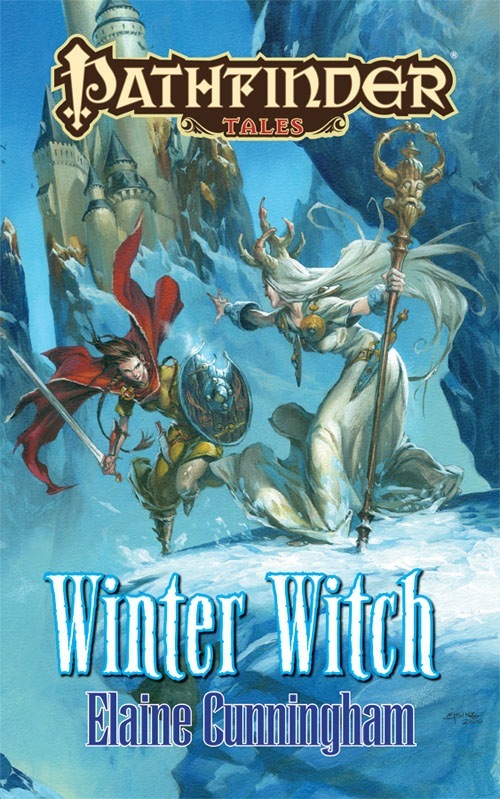
Winter Witch


It’s been quite awhile since I last read a novel based on a game world. Years ago, I voraciously read through the Dragonlance Chronicles when that trilogy was first published. I remember enjoying the books at the time, but when I reread them a few years later, my opinion of them diminished considerably. I went on to read numerous other Dragonlance and Forgotten Realms books and a few books based on other game worlds as well. While I found the odd one to be enjoyable (I remember finding The Black Vessel, a book set in the Mystara setting, to be particularly fun to read), I became increasingly disappointed with them the more I read. I found them poorly written, with cardboard characters and plots that were unoriginal, predictable, and dull. Worst of all, they rarely seemed to have much setting flavour, seeming more like generic Tolkienesque fantasy novels that were simply shoehorned into the given setting. Eventually, a little over ten years or so ago, I gave up reading them altogether.

Fast forward a decade. It occurred to me that, while I continued to be quite critical of game novels, not having read any for so long meant that I had no way of knowing whether they were still as bad as they once were, or if the quality had increased. Perhaps they had never been as poor as I remembered, as no doubt my tastes had changed a bit in the passing decade, or maybe I had just poorly chosen the novels I did read (as I certainly didn’t read every novel available back then, only a small sample really). So when Paizo started releasing their Pathfinder Tales series of novels based on the Golarion setting, I began to ponder whether I should pick one up and read it. Recently, I decided to do just that and bought myself a copy of Winter Witch by Elaine Cunningham*. I had read a short story or two by Cunningham and was impressed by them, so I figured her novel would be a good choice to start with.

Monday, 19 September 2011

Minority Characters in Science Fiction and Fantasy Literature

For the last week, I've been following the response to this article on Rose Fox's blog, Genreville, hosted by Publishers Weekly. The article publishes an open letter from authors Rachel Manija Brown and Sherwood Smith about their attempts to find an agent for their post-apocalyptic young adult novel and how they have been asked to either make a gay character straight or drop the character from the novel entirely as a condition for the agent to represent the novel. They ask for greater representation of LGBTQ characters in YA science fiction/fantasy literature and ask readers to vote with their wallets and make it clear to agents and publishers that there is a demand for these characters.

The story has spread across the internet and numerous blogs and has engendered a lot of response, much of it initially sympathizing with Rachel Manija Brown and Sherwood Smith. Even though the authors went out of their way not to name the agency in question, rumours began flying, and the agency has come forward with a rebuttal posted on Colleen Lindsay's blog, the Swivet. In it, Joanna Stampfel-Volpe denies the accusations of Brown and Smith and says that book was rejected for other reasons. Lindsay, a known LGBTQ advocate and a self-identified queer woman, follows up the response with a statement in support of Stampfel-Volpe. Genreville has since posted a follow-up which includes an excerpt of Stampfel-Volpe's response and a further response from Brown and Sherwood reaffirming the truth of their original letter.

Naturally, this has caused all sorts of discussion across the internet with people taking one side or the other, and many others coming somewhere in the middle and thinking that this all the result of a miscommunication. Cleolinda Jones excellently summarizes the whole debate on her blog, and YA Highway has a great summary as well, so I won't go through it all here other than to say it's worth reading through.