Showing posts with label Wrath of the Righteous. Show all posts

Wednesday, 12 March 2014

Wrath of the Righteous Player's Guide


The player’s guide for an adventure path is an important book for setting up the campaign and getting the players started. The successful guides help players to create characters that will fit into the adventure path, have a decent chance of surviving it, and be enjoyable to play. A less successful guide might give players a wrong impression of what the adventure path is about, resulting in characters that don’t fit. The Wrath of the Righteous Player’s Guide is certainly one of the more successful ones. It makes clear what the adventure path entails and gives useful background information, although it is lacking a bit in the advice department.

Like many adventure paths, Wrath of the Righteous tries out some new ideas and new mechanics. The most obvious, in this case, are the rules from Mythic Adventures, but the campaign also makes use of rules from Ultimate Campaign, in particular the downtime and mass combat rules. Wrath of the Righteous also tries something new with campaign traits. As usual, the six campaign traits provided in the Player’s Guide provide backgrounds for the characters that tie them to the adventure path in various ways. Each trait is also tied closely to one of the six mythic paths. Choosing a trait does not mean that the character must later choose its associated mythic path, but rather that the trait and the path compliment each other well. But what makes these traits different than the usual campaign traits for adventure paths is that each of these traits leaves something unresolved from the character’s past—something that will come into play during the adventure path itself.

While I think this added aspect of campaign traits has a lot of potential to enhance the adventure path, it also brings with it a couple of problems. I spoke of these problems in my review of Demon’s Heresy, but I’ll discuss one of them here again in a less spoilery way. The biggest problem they introduce is what to do in the event of character death or new characters joining (due to a change in players). It’s recommended that every character have a different campaign trait, but there are only six altogether. There are suggestions with each trait on how to handle multiple characters having them, but in all cases, these suggestions are for multiple starting characters. If new characters are introduced during the campaign, there’s a very good chance they won’t have one of the campaign traits, which will make more work for the GM when the time comes for the traits to be resolved. This same problem can also occur if one (or more) of the players simply isn’t interested in any of the traits and chooses not to take one of them. On the whole, this is not an insurmountable problem, but one that both players and GMs should be aware of so that accommodations can be made if necessary.

Wrath of the Righteous - City of Locusts


The Wrath of the Righteous adventure path is the first of its kind. Not only is it the first Pathfinder Adventure Path to take characters all the way to twentieth level, it’s also the first to make use of the rules from Mythic Adventures, and thus the first to take characters to power levels even 20th-level characters cannot match. It also attempts to tell a tale of larger impact than most other adventure paths, one where the fate of the world is at stake and the PCs must confront the ultimate of evils. In this latter regard, it is mostly successful. The adventure path starts with a bang in The Worldwound Incursion, which is a truly phenomenal adventure. It keeps the stakes up throughout with only momentary falters. It manages to be mythic in more than just the sense that it uses mythic rules—it is mythic in scope and style. And it deserves a finale that is epic and climactic in scope.

Unfortunately, City of Locusts, the final instalment, by Richard Pett, falls short of this. In one regard, one shouldn’t judge it too harshly. It had an incredibly lofty to goal to accomplish, one that is extremely difficult to achieve, and it does come close. On the other hand, however, after the brilliance of the adventure path’s opening and its most recent instalment, Herald of the Ivory Labyrinth, City of Locusts ends up feeling like something of an anti-climax. Despite the massive amount of power at the PCs’ hands and the unbelievably powerful foes they must face, the adventure is lacking an important aspect, one that is ultimately a flaw of the entire adventure path (but hasn’t really been noticeable until now), and not just this adventure alone.

I should make it clear that I do think City of Locusts is a good adventure. It’s just not a good enough finale.

SPOILERS FOLLOW

Tuesday, 4 March 2014

February Round-Up, Pathfinder Legends, and Wrath of the Righteous Poster Map Folio


Another month has come and gone. It was a fairly quiet month for me here on the blog, particularly in the world of Doctor Who. However, I did review the excellent and very important book Doctor Who and Race. I highly recommend people read it! I also wrapped up the third series of Sherlock with “His Last Vow” and took a little look back at Babylon 5 in honour of its 20th anniversary. In the world of Pathfinder, I looked at three products: Herald of the Ivory Labyrinth, People of the Sands, and Osirion, Legacy of Pharaohs.

In some exciting Pathfinder news, this month sees the release of the first Pathfinder Legends, a series of audio dramas from Big Finish, who are most well known for their Doctor Who audio dramas. The first release is Rise of the Runelords: Burnt Offerings, based, of course, on the first Pathfinder Adventure Path volume. You can listen to a trailer at the link. To be honest, I’m not all that impressed by the trailer, which surprises me as you would expect the trailer to showcase the very best of the production. Still, Big Finish has a very good record with their Doctor Who audios—enough of a record that I am very confident in their ability to do a very good job with Pathfinder Legends. You can purchase copies from Big Finish or from Paizo. Alas, much like with Big Finish’s Doctor Who material, personal budgetary constraints mean I’m not going to be able to pick any of these up in the near future. Hopefully one day, though. One day...

I’ll wrap things up with a short review. Here’s to a great March!

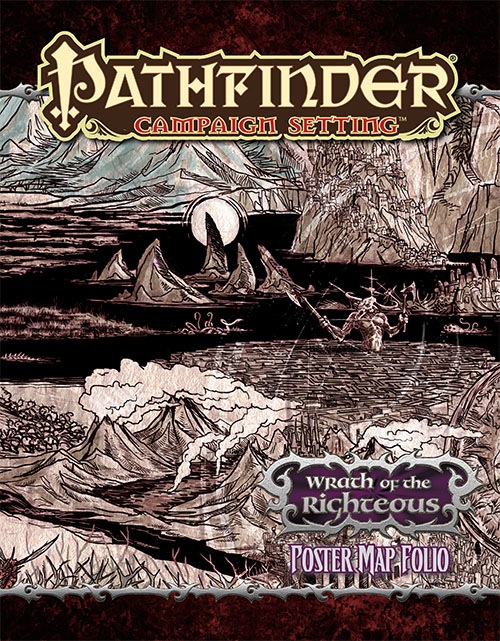
Wrath of the Righteous Poster Map Folio

As with most map folios for the adventure paths, the Wrath of the Righteous Poster Map Folio comes with three large, full-colour maps. One is a map of the Worldwound, the area where most of the action of Wrath of the Righteous takes place. The second map is of Kenabres, the city where the adventure path begins in The Worldwound Incursion. Both of these maps are high-quality and beautiful to look at, while also being highly useful for playing the adventure path. Admittedly, the map of Kenabres is really only useful for the first adventure, but the map of the Worldwound will be useful right up to the final instalment.

However, the stand-out map of this set is the third one: a map of the Abyss (which the PCs travel to in the fourth and fifth instalments of Wrath of the Righteous). Mapping out the Abyss is a daunting task—no, more an impossible task really, considering the Abyss is essentially an infinite plane made up of countless other planes. What this map does instead is provide an artistic rendition of the various Abyssal realms and “where” (metaphorically speaking) they are in relation to each other. Admittedly, the map doesn’t have a lot of utility in actual game-play. However, I don’t really care. The map is utterly beautiful to behold and can easily serve as an in-game representation of the Abyss—something the players’ characters might actually see. Ultimately, this map provides a visual element to enhance game-play. It gives both players and GMs just a little hint on what their characters are seeing, allowing the imagination to fill in the rest. It also makes a great poster to hang on the wall.

Wednesday, 12 February 2014

Wrath of the Righteous - Herald of the Ivory Labyrinth


Mazes are a staple of mythology and fantasy fiction, dating back at least to the story of the Minotaur. Yet mazes in roleplaying game adventures are often...well, to put it bluntly, boring. There’s only so long one can discuss turning left or right yet again at the latest intersection. On top of that, the use of miniatures (which is pretty much necessary in a Pathfinder game) makes it hard for a game master to make a maze challenging since the players have an overhead view that their characters don’t have. In the foreword to Herald of the Ivory Labyrinth, James Jacobs talks about this very problem and the conundrum this creates with an adventure path that takes the PCs to the realm of Baphomet, demon lord of minotaurs. An entire plane that is one giant maze is a fascinating concept, but can it work as the setting for an adventure?

The answer is a resounding yes. It entails a different approach to mazes than what many roleplayers may be used to, but it’s one that manages to retain the awe and mystery of mazes without the tedium of describing every single turn. In doing so, Herald of the Ivory Labyrinth, written by Wolfgang Baur, manages to be one of the most original and exciting outer plane adventures I’ve read in some time. While The Midnight Isles, its immediate predecessor in Wrath of the Righteous, is rather ordinary as far as planar adventures go, Herald brings back the mythic feel that was present in the earlier instalments of the adventure path. This is an adventure where the PCs face off against some of the deadliest foes in the multiverse, but also leaves ample room for investigating, roleplaying, and drama. And it brings with it some incredible rewards for the PCs—assuming they succeed, of course.

SPOILERS FOLLOW

Wednesday, 29 January 2014

Wrath of the Righteous - The Midnight Isles


As Pathfinder (and D&D) games reach higher levels, it becomes quite common for PCs to take their adventures to other worlds and planes of existence. Planar travel has been a long-standing part of the game since its earliest days, with many adventures set in various locations across the multiverse (and even an entire campaign setting, Planescape, designed around planar travel). The Worldwound area of the Pathfinder Campaign Setting contains a direct portal to the abyss, through which demonic forces have been able to invade. With the Wrath of the Righteous adventure path set in and around the Worldwound and dealing with the crusades to end the demonic invasion, it was only inevitable that eventually the PCs would take the fight to the Abyss itself—which is precisely what happens in the fourth instalment, The Midnight Isles by James Jacobs and Greg A. Vaughan.

As the first adventure path to utilise the mythic rules, Wrath of the Righteous, thus far, has maintained a suitably mythic feel. Indeed, The Worldwound Incursion accomplished that without actually adding anything mythic until the very end. While all adventure paths are, in a sense, mythic in scope (by virtue of dealing with a storyline covering an entire campaign, one in which the PCs are likely to become well-known heroes), Wrath of the Righteous has managed to go one step further. It’s not just the presence of more powerful monsters (made necessary by the fact that mythic PCs are just a little bit more powerful than non-mythic PCs); it’s the intricate storyline where the consequences of failure are just a little greater, as well as the diverse cast of fully fleshed-out NPCs who create the opportunity for intricate relationships and roleplaying opportunities. The PCs go from barely surviving a demon attack on the city of Kenabres to being the saviours of that city to then liberating a city long in the thrall of the demons. They have found and rescued a redeemed succubus, and have uncovered the details of the demons’ terrible plans.

As such, it’s a little bit surprising that, as they now head off to the Abyss itself, The Midnight Isles is the first adventure in Wrath of the Righteous to lose that mythic quality and feel like just another adventure. It’s a decent adventure, sure, but it doesn’t stand out the way the other instalments in this adventure path have. In part, this is because planar adventures already have many of the qualities that make an adventure feel “mythic” and so, in order to make them stand out even more, they have to have something more than other planar adventures have—and I really don’t think this one does. In part, it’s also due to the fact that this adventure feels rather “done before”. It bears a lot of similarities to some earlier Paizo adventures, particularly parts of the Savage Tide adventure path. Of course, to a certain extent, all adventures reuse common patterns and tropes, but this one seems to do so to a greater extent. In his foreword, James Jacobs explains that the reason there are two authors on this adventure is because he and Greg A. Vaughan helped each other out due to both of them have very busy and tight schedules. It’s therefore not surprising, I suppose, that in order get it completed, they had to rely on reusing tried-and-true tropes. But alas, tried-and-true does not make for a mythic feel. The result is a planar adventure that seems rather ordinary when compared to the adventures that have led up to it.

SPOILERS FOLLOW

Sunday, 15 December 2013

Wrath of the Righteous - Demon's Heresy


There comes a time in every campaign when the PCs want to take a break. Sometimes, this is just a short period to rest and recover from wounds before heading back out on adventures. Other times, it lasts longer, while the PCs take care of non-adventuring concerns, develop relationships with NPCs, build businesses, craft magic items, or just plain relax. Some gaming groups gloss over these periods with a simple statement of “A few weeks pass;” while other groups play out each day along the way. But however they choose to deal with this period of “downtime”, every group goes through it from time to time.

It’s natural that the amount of downtime that occurs varies depending on the campaign and the particular group. Some campaigns will experience very little downtime, and what downtime there is may often be short. This tends to be the case with many Pathfinder adventure paths. It’s not unusual for one instalment to lead directly into another with little, if any, gap between them. This is not universal, of course. Most adventure paths allow for at least a little downtime and some allow for a bit more, but on the whole, the amount of downtime tends to be small. As such, it’s nice when an adventure path instalment comes along that allows the characters to settle for a little while and take it easy a bit—of course, even during downtime, things are rarely truly easy.

Demon’s Heresy by Jim Groves, the third part of Wrath of the Righteous is one such adventure. After the harrowing events of The Worldwound Incursion and Sword of Valor, it allows for the PCs to take a bit of a breather and even experience a little bit of semi-calm. Looked at on its own, it doesn’t have same epic quality to it that the earlier instalments have, but to look at it on its own would be to do it an injustice. While there are some adventure path instalments that could easily be run on their own without running the remainder of the adventure path, Demon’s Heresy really isn’t one of them. It’s a piece of a whole and its less-epic structure is more like the calm at the eye of the storm—except that this storm’s eye is pretty fraught with peril and adventure.

SPOILERS FOLLOW

Saturday, 26 October 2013

Wrath of the Righteous - Sword of Valor


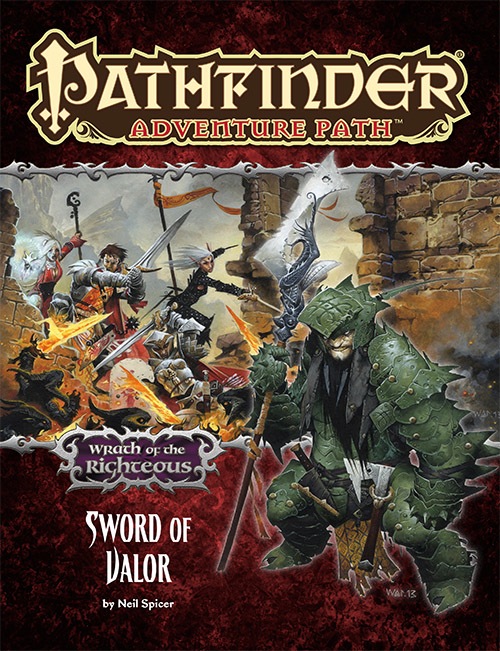
As I mentioned in my review of The Worldwound Incursion, when Wrath of the Righteous was first announced, I wasn’t all that interested in it. I didn’t expect it to be bad; I just didn’t expect it to be all that remarkable either. However, The Worldwound Incursion blew me away. That volume, combined with the excellent The Worldwound sourcebook, opened my eyes to an area of Golarion I had paid little attention to. Of course, a great opening instalment to an adventure path doesn’t necessarily guarantee a great adventure path overall. There have been adventure paths with excellent first volumes that have been followed up with mediocre to poor second and third volumes (Serpent’s Skull comes to mind). Luckily, the second volume of Wrath of the Righteous, Sword of Valor by Neil Spicer is not one of those sub-par follow-ups. Instead, it may just be setting up Wrath of the Righteous as one of the best adventure paths to date. It manages to wrap overland travel, mass combat, dungeon crawling, and extensive roleplaying options up into one really quite brilliant adventure.

SPOILERS FOLLOW

Sunday, 22 September 2013

Wrath of the Righteous - The Worldwound Incursion


After a few products dealing with the theme of dragons (Dragons Unleashed, the Dragonslayer’s Handbook, and The Dragon’s Demand), the latest themes for Paizo products are demons and mythic. Demons are a major focus of The Worldwound, Demons Revisited, and the Demon Hunter’s Handbook (the latter two being products I will be reviewing in the not-too-distant future). Mythic is the major focus, not surprisingly, of Mythic Adventures, but it is also the focus of Mythic Realms and Mythic Origins (two more products I’ll be getting to in the coming weeks). The new adventure path, Wrath of the Righteous, focuses on both.

When I read The Worldwound, I was rather surprised by how much I liked it. It deals with an area of the world I was never particularly bothered about, but the book showed me just how interesting and compelling an area it is. As Wrath of the Righteous is set in that area and deals with the Mendevian crusades against the demons (something else I wasn’t overly interested in), I didn’t really expect it to interest me a great deal. I didn’t expect to dislike it either. Rather, I just expected it to be a good, but unremarkable adventure path. Expectations can be glaringly wrong, however. The Worldwound helped raised my expectations for the adventure path, and reading some of the initial response to the first volume raised them even more. By the time I finally got round to reading it myself, I was quite eager.

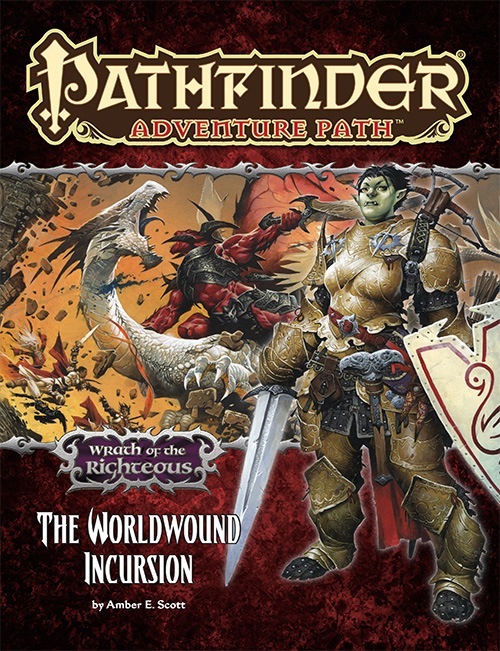
And I have to say, The Worldwound Incursion by Amber E. Scott absolutely blew me away. A couple months ago, I declared Rasputin Must Die! to be one of the best adventures I had ever read. Well, it’s entirely possible that adventure now has a rival. I don’t make statements like that lightly (and anyone who reads my reviews regularly knows I can be very exacting in my standards), but from start to finish, this is one epic and exciting adventure. It’s definitely worthy of the term mythic. If this adventure is anything to go by, the remainder of Wrath of the Righteous will be simply stunning.

SPOILERS FOLLOW