Throughout
the Giantslayer Adventure Path, the player characters have taken on
the servants of Volstus, the Storm Tyrant and the forces they’ve
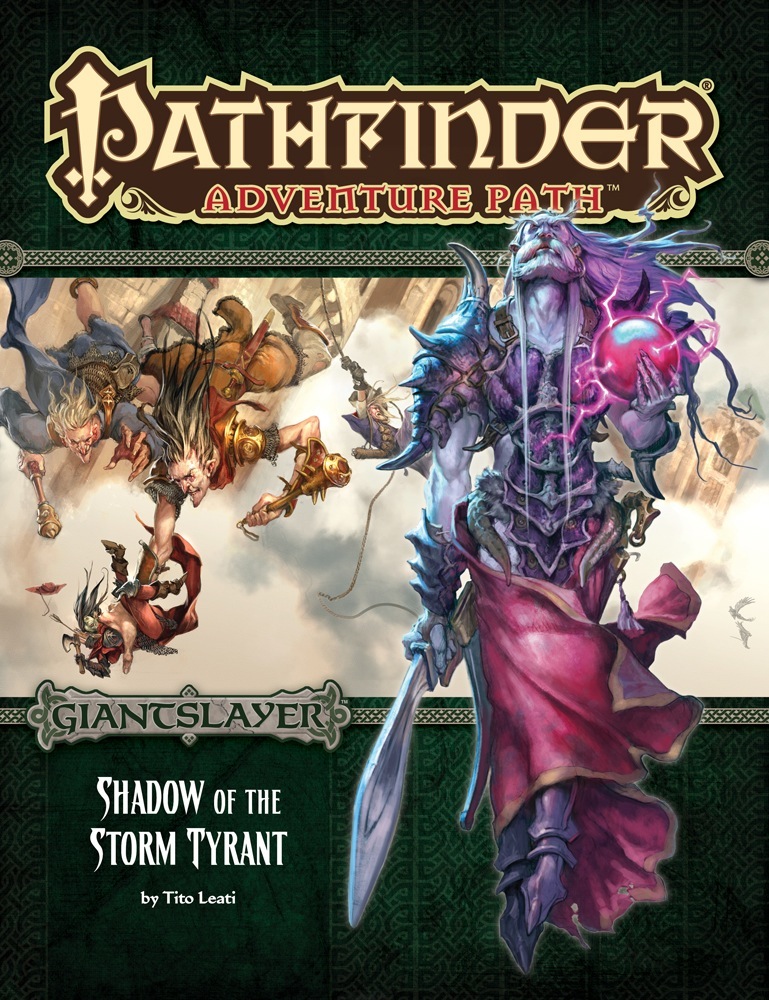
been building in the Storm Tyrant’s name. In Shadow of the Storm Tyrantby
Tito Leati, the PCs finally
make their way to the Storm Tyrant’s cloud castle and take the
battle directly to him.
I’ve
had mixed opinions of the instalments of Giantslayer so far—some
have been good, others not so good—but Shadow of the
Storm Tyrant works well as the
culminating adventure. It’s primarily a dungeon crawl, but has a
good sense of urgency and variety that its predecessor, Anvil of Fire, is missing. It
also has some epic-feeling encounters and combats appropriate for a
high-level party, and it makes good use of its setting, which helps
to turn what could have been just a bog-standard dungeon crawl into
something much more unique.
While
conflict with villains and monsters is a significant part of any
roleplaying game, the game would be considerably less interesting if
the PCs didn’t have friends and allies as well. Whether they’re a
local inn-keeper providing the PCs a room to sleep in or a loyal
cohort who accompanies the PCs on their adventures, these friendly
characters help fill out the rest of the world and provide variety
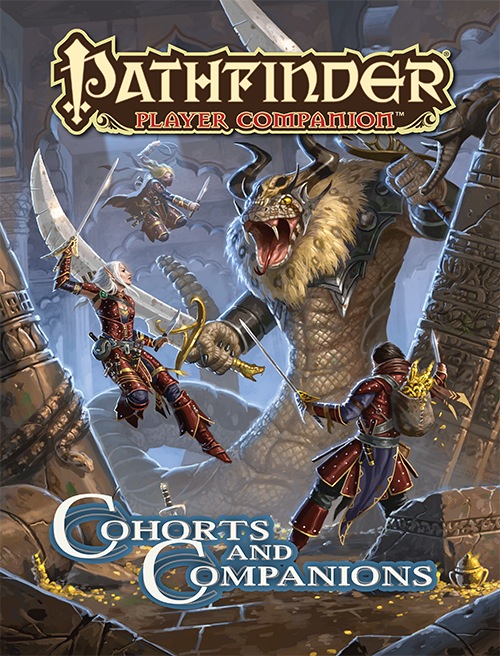
beyond evil and/or monstrous opponents. Pathfinder Player Companion: Cohorts and Companions
focuses on the followers and allies
who aid the PCs in various ways throughout their adventuring careers.
As
the book’s name implies, cohorts (gained from the Leadership feat)
are a significant focus, but the book also goes considerably beyond
these. The “Companions” part of the title can refer to animal
companions, but also to pretty much any other person, animal,
monster, or even object that in some way accompanies or aids the
PCs—and
there is quite an impressive breadth of options covered.
The
book opens with a two-page
discussion about why NPCs
might follow PCs, and how PCs
might go about gaining followers. This
includes things like hiring
NPCs as well as NPCs just following along for their own reasons.
Naturally, there’s a fair amount of discussion about the Leadership
feat, as well as mention of the variant Leadership
feats that can be found in
other products: Squire from Knights of the Inner Sea,
Torchbearer from Dungeoneer’s Handbook, and Vile
Leadership from Champions of Corruption. There is also
a very good sidebar on “Who Controls Cohorts?” which discusses
how to decide whether the GM or player (or a combination of both)
gets to control cohorts’ actions.
Just
under two weeks ago, the Pathfinder Playtest launched. This is an
open playtest for the 2nd Edition of the Pathfinder Roleplaying Game.
It includes the Pathfinder Playtest Rulebook,
the Pathfinder Playtest Bestiary,
and Doomsday Dawn, an
adventure made up of several sections, each focusing on a specific
aspect of the game for playtesting. You can download free PDFs of all of
these, plus other materials like character sheets from the
Pathfinder Playtest website.
This
is not a review. It doesn’t really seem appropriate to write a
review of a work-in-progress. However, it does contain some of my
thoughts about the game (which I suppose is review-like). Since I
concentrate fairly heavy on Pathfinder products on Of Dice and Pen, I
figured my readers may
be just a little curious about my thoughts and why I won’t be
talking much about 2nd Edition Pathfinder for the foreseeable future.
When
2nd Edition was announced, I was cautiously excited. I believe the
game is due a new edition. I have commented in many of my reviews
that it has grown to a size where it’s impossible to keep track of
things. There are so many choices that the vast majority are never
used. The game is also convoluted with overlapping, redundant options
or even sometimes contradictory options. Pathfinder has been out for
nearly ten years now (and will have been by the time 2nd Edition
launches fully next year) and a lot of material has been published
for it, so it’s not surprising that it’s become somewhat bloated.
However, I also think Pathfinder is still a very playable game. It
just needs a bit of consolidation and a few alterations and fixes
here and there.
After
the announcement of 2nd Edition, Paizo began releasing regular
previews of the game on the Paizo Blog, and I followed
along, eager to see what the
game would be like. At first,
I liked a lot of what I was seeing (the
action economy system, for example, based on the one from Pathfinder Unchained, which I
already use in my games).
Unfortunately, it soon became clear that the changes were far more
extensive than what I was looking for. This wasn’t so much a
revision of the game as it was a complete rebuilding of it—more
like the change from D&D 3.5 to 4th Edition D&D instead of
3.5 to Pathfinder, which is more along the lines of what I want. I
have a lot of Pathfinder products that I haven’t had a chance to
use yet—adventure paths I’d like to run, for example—and
converting them to the new edition would be just too large a task
that I don’t have the time for.
And
while there are things in the new game that I like, there are also
several things that just don’t appeal to me. “Resonance” is one
such thing. This is a new mechanic for limiting magic item use and
replaces things like magic item slots. Basically, every character has
a number of Resonance Points and using or “investing” (for
worn items) a magic item requires spending Resonance Points. If you
run out of Resonance Points, it becomes more difficult to use a magic
item and you need to make checks. The idea is that the character
needs to use a little bit of their own innate magical talent to
activate a magical item. My problem with Resonance is not on the
mechanical side. For me, it changes the entire feel of the game.
Pathfinder and D&D before
it have always had some items that can be picked up by anyone and
used. There is nothing necessarily wrong with a game or setting that
requires expending innate ability to drink a potion, but that’s not
Pathfinder to me. I changes the dynamic and that doesn’t appeal to
me.
I
will not be using the Playtest rules with any of my games. All my
current games will keep with 1st Edition rules for the remainder of
their campaigns. I will absolutely take a look at the final rules for
2nd Edition when they release next year, and depending on how they
develop, I might consider using them for future campaigns. However, I
suspect I will be remaining with 1st Edition. As I said, I’ve got
lots of books waiting to be used—more than enough to last me for
many years worth of gaming. There are also a whole pile of books left
that I haven’t yet reviewed here, so I’ve got lots to keep me
busy on here for quite some time too.
Please
note that, while I don’t intend to switch to 2nd Edition at this
time, I have nothing against Paizo for producing it or anyone who
plans to make the change. As I said, I think the game is due a
change. It just so happens that change has gone in a different
direction to what I personally would have preferred.
Every
adventure path has a low point. It’s pretty much unavoidable.
There’s always going to be something that doesn’t work quite as
well as everything. Of course, the hope is that any low points are
still high—still good and fun, just not quite as high as the other
points in the adventure path. If this situation is met, you have a
winning adventure path. Unfortunately, Giantslayer isn’t an example
of this. Even more unfortunately, its low point sinks especially low.
After
Ice Tomb of the Giant Queen,
I worried that the adventure path was becoming repetitive. Three
instalments in a row all follow a very similar style where the PCs
need to infiltrate much larger and potentially overpowering forces in
order to achieve their goals. I worried that this repetition could
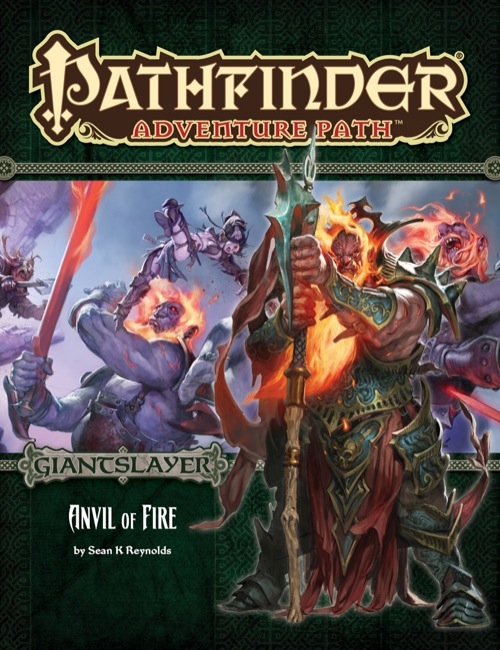
start to bore the players. Anvil of Fireby
Sean K Reynolds, the fifth
part of the adventure path, is only superficially similar in this
regard and mostly breaks from the pattern established in the last
three parts. Unfortunately, it’s repetitive in an even worse way:
with itself.
Anvil
of Fire is one long dungeon
crawl with battle after battle after battle—with almost every
encounter being virtually identical to the one immediately before it.
There is very little
opportunity for pause (except if and when PCs decide to retreat from
the dungeon to recover) and even less opportunity for interaction
with NPCs in any way other than combat. There is so much of the same
in this adventure, I can’t imagine any group of players not being
completely bored by the end. Even the most avid “hack’n’slash”
players will likely be dismayed at the lack of variety in the
combats.
Fantasy
roleplaying games allow an escape from reality. They allow us to play
out stories with magic, elves, and dragons that could never happen in
the real world. Yet they retain elements of the real world, often
taking aspects of real world history and cultures to inspire the
peoples and societies that populate them. These elements allow the
game to retain a certain sense of familiarity, and a certain sense of
reality amidst the fantasy.
But
sometimes, you just want to abandon reality altogether, get rid of
the familiar as much as possible, and create something truly
different. This can be through travel to other worlds or even other
planes. Planar travel has been a mainstay of roleplaying since its
earliest days. It’s often something only embarked upon by
high-level characters who have acquired the greater powers needed to
make the jump from one plane to another, but it doesn’t have to be.
The old 2nd Edition Dungeons & Dragons campaign setting,
Planescape made PCs natives of other planes and incorporated
plane-hopping right from first level.
The
Pathfinder Campaign Setting first outlined its planar structure in
the old Pathfinder Chronicles: Campaign Setting book (later
updated as Pathfinder Campaign Setting: The Inner Sea World Guide).
The information in that book was later expanded upon in The Great Beyond. But even
that book could only provide the barest details. The planes are more
than just other worlds; they are entire other universes with enough
space in each one to hold millions of entire campaign settings.
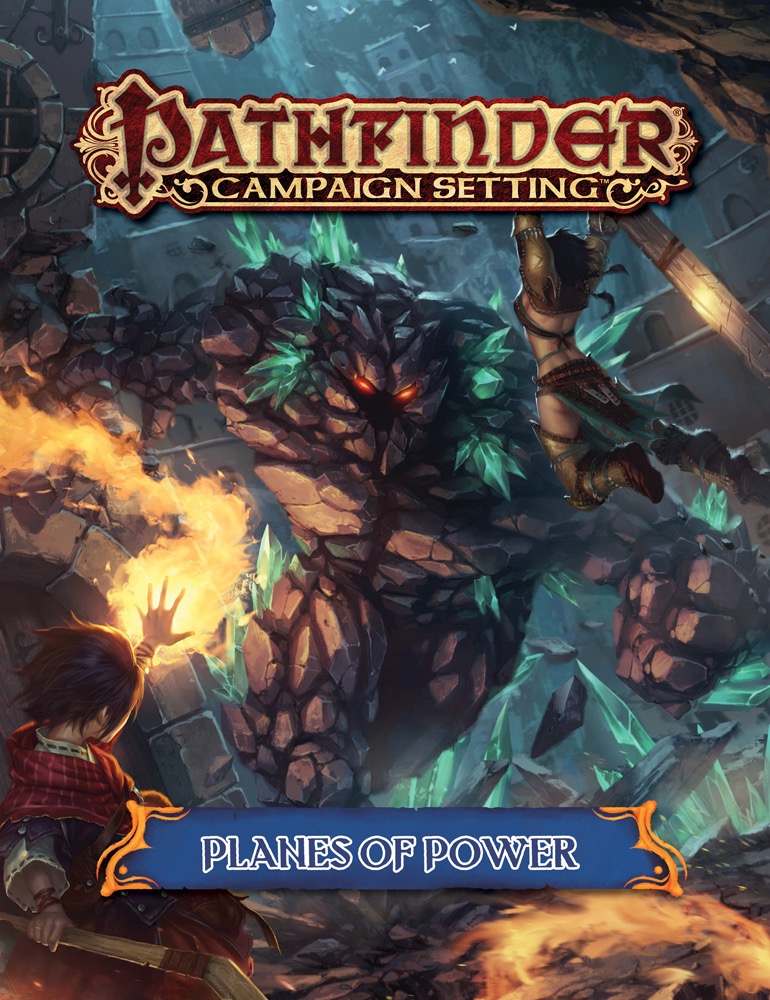
Planes of Power is a more recent
book that takes a much closer look at just four of the many planes
that make up the Great Beyond—specifically
the Elemental Planes of Air, Earth, Fire, and Water. Of course, this
book can still only scratch the surface of these planes, but it is
able to provide enough of a backdrop to whet GMs’ creative juices
and allow them to expand beyond what’s presented.
What
is the difference between science fiction and fantasy? The two are
often grouped together. Fans of one are usually fans of the other as
well, and indeed the two often overlap. Much that is labelled science
fiction contains things that are outright fantastical. The Star
Wars series is one of the most
extreme examples of this. Called science fiction, it follows the
formula of epic fantasy, complete with wizards (jedi), monsters, and
heroes fighting the forces of evil. It uses the trappings of science
fiction (spaceships, faster-than-light travel, lasers), but without
any actual science behind them. The reverse happens as well, with
many fantasies containing scientifically plausible ideas. So where is
the line between the two? Does that line even really exist?
All
the Birds in the Sky by Charlie
Jane Anders plays around with the separation
between science and fantasy. It jumps back
and forth from one side to
the other of that hard-to-define line, all
the while effortlessly deconstructing the idea that there’s even a
line in the first place, demonstrating that, in the end, both science
fiction and fantasy are just story-telling.
It
does this for more than just science fiction and fantasy, too. It
tears apart the lines between comedy and serious drama, being both
hilarious and deadly serious, fun and emotional. There are moments of
action that wouldn’t be out of place in a Transformers
movie, while also being a book about normal everyday life, from
children dealing with bullies at school to the sex lives of young
adults. Indeed, the book defies most attempts to slap a genre of any
kind on it, and it is all the more delightful because of it.
It
even defies expectations on a meta-textual level. The book is written
in third person limited (meaning it focuses on the point of view of
one character at a time), alternating chapter-by-chapter between its
two protagonists. Except every once in a while, when the two
characters are together, the perspective switches back and forth
between them from one paragraph to the next. On other occasions, the
perspective widens out to other characters. Even though this can be
unexpected (third person omniscient is rarely used these days), it’s
never jarring. Anders makes it seem completely normal and natural—she
makes you think you were expecting it.
Long-time
readers of this blog may recall my excitement four years ago when
Cosmos: A Spacetime Odyssey
premièred. Both an update and a sequel to Carl Sagan’s
ground-breaking 1980
series Cosmos, Cosmos:
A Spacetime Odyssey was hosted
by Neil deGrasse Tyson and covered a variety of topics concerning
humanity’s place in the universe, from the smallest atoms to the
largest galaxies, and everything in between. It was both beautiful to
watch and highly educational. It’s a series I strongly recommend
for gaining a better understanding of science and the world around
us.
It’s
been a while, but the great news is, Cosmos
is coming back for another season! Cosmos: Possible Worlds
will air next year. I’ve known about this for some time now, but
what I’ve only just learnt is that a
new trailer came out last
week. Have a watch!
Educational
programming is important, and in many ways, science programming is
especially so. Cosmos is
far from the only science show out there (and
there are many good ones, too),
but it is one of the most high-profile, and that helps bring it to a
larger number of people. We
live in a time when science is more and more frequently coming under
attack. In the United States, in particular, people in power try to
place
topics like climate change under the heading of “fake news” and
push creationism as being on the same scientific level as evolution.
It’s
not limited to the States, though. I live in Toronto, Ontario,
Canada. Here in Ontario, we have recently elected a new conservative
government that is already seeking to scrap environmental protections
put in place by the last government and is fighting against the
federal government’s attempts to keep those or similar
environmental protections in place. This same provincial government
is also scrapping a newly established sex education programme for
Ontario students and replacing it with an out-of-date programme from
1998. And they’re doing
this for reasons based entirely around misinformation (see here for a good overview of this situation).
As
a teacher, I welcome any attempts to bring science and education to
people young and old. One of
the best ways is to present science in a way that is entertaining and
stimulating. Cosmos: A Spacetime Odyssey
does this through the use of thrilling visuals. It is truly a feast
for the eyes, on par with the numerous fictional shows and games
vying to grab the attention of viewers. Along with these visuals,
Cosmos also presents
its subject matter in a straight-forward, easy-to-understand manner.
You don’t need a PhD in physics to understand the show. You don’t
really need any background in science at all. Yet even
for those with a background
in science, it still has much to offer, covering such a diverse array
of subjects as it does. One of the great things about Cosmos:
A Spacetime Odyssey is also how
accessible it is to people of many different ages. I’ve used Cosmos
in a classroom with 12-year-old
students and have seen it captivate adults as well.
From
the preview, Cosmos: Possible Worlds
looks to contain these same things—thrilling visuals accompanying
an accessible and entertaining discussion of scientific topics. As
Neil deGrasse Tyson says, “Things are about to get epic.” I can’t
wait!
Every
adventure path has a particular theme and style to it, which
identifies it and makes it distinguishable from other adventure
paths. Iron Gods has technology and
aliens, while Mummy’s Mask involves
exploring ancient tombs and battling undead. Giantslayer, not
surprisingly, is all about giants. Adventure paths also need a
certain amount of variety, though, as too much of the same thing can
start to feel stale. Stray too far from the core concept, however,
and the different segments of the adventure path might no longer feel
like a connected whole. It can be a fine line between how much “same”
and how much “different” an adventure path needs to work.
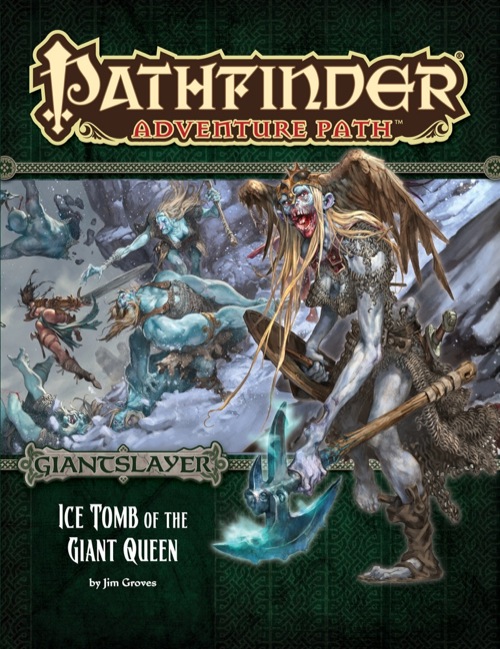
With
Giantslayer, I’m starting to feel that it’s leaning towards too
much of the same. The fourth instalment, Ice Tomb of the Giant Queen
by Jim Groves is structurally very similar to the two adventures
immediately preceding it, The Hill Giant’s Pledge and
Forge of the Giant God.
That’s not to say that Ice Tomb
is a bad adventure. It’s actually pretty good and there’s a lot I
like about it, but in it, the PCs must undertake a mission of
infiltration and sabotage just like they’ve done twice already. Of
course, as they’re higher level now, they have more options for how
to go about their
mission and they face more powerful opponents, but in the end it
still feels repetitive. It’s exacerbated by the fact that this is
not just the third time overall, but the third time in a
row.
That
aside, there’s a lot that’s very good in Ice Tomb of
the Giant Queen. It has a
dynamic and vibrant setting that provides a good sandbox location for
the adventure to take place in, and it has lots
of interesting encounters to
challenge a party of 10th-level characters and entertain their
players. It also has an
innovative system for determining how their giant opponents respond
to the PCs’ actions.
Since
“Twice Upon a Time” and the twelfth
Doctor’s regeneration into the thirteenth (played by Jodie
Whittaker), it has been very quiet on the Doctor Who
front—that is, until this week. A few days ago, we got the first teaser for the
forthcoming Series 11, and today comes the first full trailer (watch
it below) as well as the first peak at the new sonic screwdriver (see above). (Yes, I know a few pictures of the sonic screwdriver leaked
at little while back, but this is the first official look.)
The
trailer is pretty straight-forward as trailers go, with a succession
of short moments from the new series and a narration by the Doctor
over the top. There’s less to unpack from this than there was in
the teaser from a few days ago, but what this trailer definitely has
in spades is a sense of wonder and excitement. The shots and scenery
viewed are simply gorgeous. Intriguingly, there isn’t a single look
at any monsters or aliens. It focuses on the Doctor and her three new
friends, without even a single other character appearing. But that’s
okay, as far as I’m concerned. I like the greater secrecy being
kept over this series than in previous years. It helps increase the
excitement factor. I, for one, can’t wait till it starts!
Oh,
and to answer the Doctor’s
question, my answer is unequivocally yes!
(Edit: A few other characters do appear in the trailer beyond just the Doctor and her companions. They appear during blink-and-you'll-miss-them moments, but they're there.)
The
new series of Doctor Who
is still a few months away, but publicity is starting to gear up. The
newest issue of Entertainment Weekly
features Doctor Who as
its cover story and, today, the BBC released the first teaser for
Series 11.
This
is not a trailer showing scenes from the upcoming series. Instead,
it’s a specially filmed sequence to help whet the appetite for more
(and it’s probably not a coincidence that it uses food to do so).
On the surface, it says very little about what to expect from the new
series—and that fits the more secretive style of new showrunner
Chris Chibnall, compared to both Steven Moffat and Russell T Davies
before him.
But
looking beneath the surface, there’s a lot more to glean from
this trailer. The new Doctor appears to have something of a
mischievous streak to her: Through what appears to be some sort of
time manipulation, she steals some of Ryan’s food and replaces
Graham’s newspaper with a Beano
issue (intriguingly, the same one the 11th Doctor hides behind in
“The Rings of Akhaten”).
But she has a kinder side too. When Yasmin discovers there’s no
pizza left, the Doctor helpfully replaces it. Finally, the Doctor’s
smile at the end shows a great deal of warmth and fun. There’s also
the television announcer. While ostensibly talking about sport, the
words—“They’ve got the
makings of a really great team. They’ve
got great energy. They’ve got great flare...I’m really excited to
see what happens”—also apply quite easily to the new TARDIS team.
In
just a few seconds, this teaser conveys a fairly clear feel for the
new series. I’ve already
been quite excited about the new series, and this teaser has
definitely made me more excited!