A teaser trailer was released a couple of months ago, but now the full trailer for the movie Dark Dungeons is out! Based on the Jack Chick tract of the same name, it teaches the world the evils of roleplaying games like Dungeons & Dragons. It premieres at Gen Con on August 14 and will be available on DVD after that. I can't wait!
That said, I'm still waiting to be inducted into the inner circle of D&D players, those who get to cast real spells. Jack Chick promised me thirty years ago that it would happen if I played D&D and I'm still waiting. Why's it taking so long?
Anyway, here's the trailer. RPG! RPG! RPG!
Thursday, 22 May 2014


Wednesday, 21 May 2014
Cosmos - The Immortals

This
week’s Cosmos is one of the
more speculative episodes so far, delving into the questions of life
that we don’t fully have the answers for yet. But that makes it no
less a beautiful and enlightening episode than any other so far. In
many ways, speculation is one of the most important parts of the
scientific process. Certainly, speculation can be (and often is)
wrong, but without the speculation, there is little to drive us to
the truth. “The Immortals” looks at one of the biggest questions
of all: Where did life come from? But more than that, it looks at
where life is going. Does humanity have what it takes to survive, or
will it, one day, just be added to the list of extinct species?

Humanity
has often looked for immortality—a way to escape the shackles of of
an individual’s short time on this planet. But there are different
kinds of immortality, and even though “The Immortals” opens with
the question, “Are there beings in the cosmos who live forever?”
the episode doesn’t concern itself with the idea of a single
individual being able to literally live forever. Instead, it takes
the route Cosmos has
taken previously where records of an existence (from pictures to
writing) are a form of immortality. The episode takes us back to
ancient Uruk and the Akkadian priestess Enheduanna, who was one of
the earliest known poets and authors, and the first person to ever
sign her name to her work, ensuring that her name would be recognized
long after her death. From there, we learn of the Epic of
Gilgamesh, which is the earliest
example of the hero’s journey. Gilgamesh sought immortality, and in
a sense, he found it because his name is still known today. Writing
and stories are a way of preserving the past, and so, are a way of
keeping their subjects alive potentially forever.
Monday, 19 May 2014
Inner Sea Combat
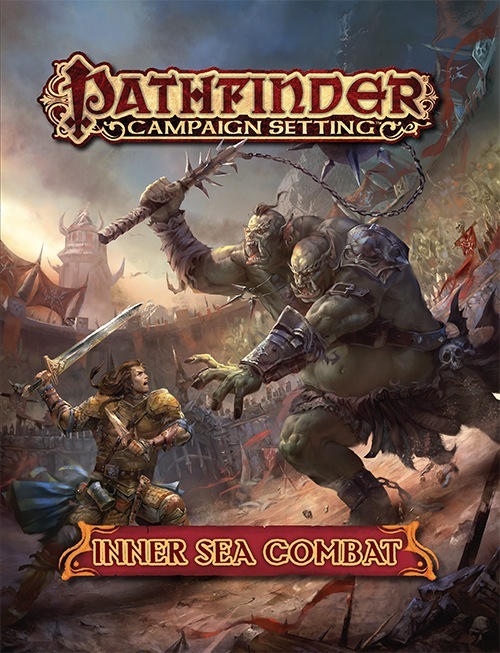
I’m
a bit surprised it took as long as it did for Inner Sea Combat to come out.
After all, it’s been over two years since Inner Sea Magic was released,
and the two books seem obvious companion books (in the same sort of
way one can think of Ultimate Magic
and Ultimate Combat as companion
books). However, whatever the reason for the long gap between the
books, it’s good to see combat in the Pathfinder Campaign Setting
getting the same attention that magic has already gotten.
Inner
Sea Combat provides a ton of new
options for combat-oriented characters. But this is more than just a
book of new feats and other new rules options. Everything in this
book is tied to the Golarion setting and, while it’s certainly
possible to separate the new options from the setting and use them
without the context, I honestly think most of them will lose a great
deal in such a case. There’s a wonderful amount of flavour to the
options in this book, and they all build on aspects of the campaign
setting—many of them things that have been mentioned in other books
but not dealt with in detail until now. The book is organized
similarly to Inner Sea Magic,
opening with a descriptive look at combat across the Inner Sea region
(including a list of prominent NPCs), then providing details on
variant forms of combat, new character options including a couple of
prestige classes and a ton of new archetypes, and ending with an
extensive selection of new magic items. People who criticize Ultimate
Combat for having a spells
chapter will be happy to know that there are no new spells in this
book.
Friday, 16 May 2014
Cosmos - The Electric Boy

There
are a lot of things that we take for granted in our modern world, the
ability to communicate over vast distances almost instantaneously
being one such thing. Phones are ubiquitous everywhere. Computers and
televisions bring us entertainment. We can hear or read other
people’s thoughts by pulling up websites like this one, or buy
things without ever having to enter a store. But how do we do that?
How do these items work? “The Electric Boy”, the tenth episode of
Cosmos answers that question
by delving into the life of Michael Faraday, the scientist who
unlocked the secrets of electromagnetism and invented the first
electric motor, amongst numerous other great achievements. As host
Neil deGrasse Tyson says, while other people probably would have
eventually made Faraday’s discoveries, if Faraday had never lived,
the world we live in today would likely be a very different place.
In
some ways, this episode is similar to “The Clean Room”, in that
it focuses so heavily on the life of just one scientist. While it
starts with a brief mention of Newton, who, after coming up with his
laws of planetary motion, was stumped by what causes
that motion, the vast majority of the episode focuses exclusively on
Faraday, who was the first to solve that problem that Newton
couldn’t. Unlike “The Clean Room”, however, there’s a bit
more look at the science itself in the vein of most Cosmos
episodes.
Mummy's Mask - Empty Graves
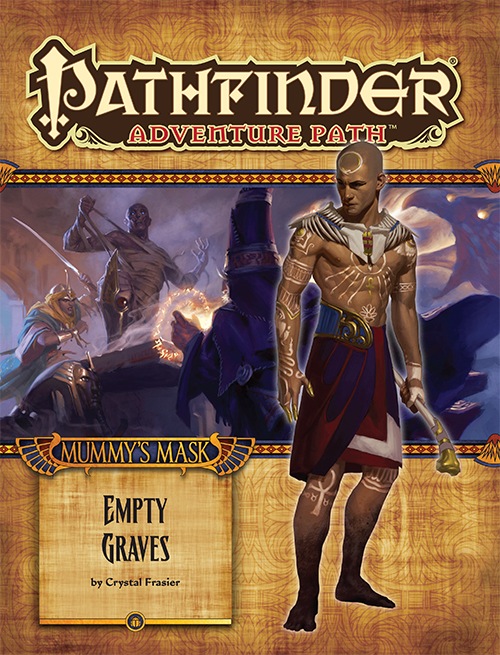
In
my review of The Half-Dead City,
I referred to it as a “calm” adventure. It is a well-made dungeon
crawl with a gradual build-up to the adventure path’s main plot—a
plot the PCs are barely aware of by the end. In the second part of
Mummy’s Mask, Empty Graves by Crystal
Frasier, the PCs get their first real taste of the overall plot as
things start to heat up considerably when the dead of Wati suddenly
animate as undead. It is a very open-ended adventure, allowing the
PCs the opportunity to make names for themselves as heroes, to build
up alliances and relationships with key people in the city, and to
eventually track down the source of this strange undead uprising and
put an end to it.
SPOILERS
FOLLOW
Thursday, 8 May 2014
Cosmos - The Lost Worlds of Planet Earth

Change
is an immutable part of life. As we go through our lives, we see
change all the time, from changing fads and fashions to changing
technologies. Some of it is quick and some of it is more gradual, but
we can’t fail to notice that it’s there. Yet there is some change
that is harder to spot, even invisible to an individual. We tend to
think of our lives as being quite lengthy. Some of us even manage to
live past a century. Yet, compared to the age of the Earth, even a
century is but a tiny fragment of time, a mere blip out of billions
of years. As such, we tend to think of the world as a stable
environment. Sure, the weather may change from day to day and the
seasons cycle through the years, but the overall patterns remain the
same—reliable and unchanging. But if we could view time through a
wider lens and see it over thousands and millions of years, we would
see just how much change it goes through. Species evolve and die off.
The climate changes. Ice ages come and go. Levels of oxygen and
carbon dioxide in the atmosphere change. The world we live in is not
the same world that existed in the distant past.
The
ninth episode of Cosmos, “The
Lost Worlds of Planet Earth” takes us on a journey through the long
lifetime of our world and gives us brief glimpses of the many worlds
Earth has been over its long life. In doing so, we learn of the
mechanisms that influence and guide climate change, along with the
catastrophes that can sometimes happen as a result. It’s an episode
that is particularly relevant to us today, as we live in a world in
which those slow, invisible changes are starting to become visible.
Climate change is happening at an unprecedented rate, due in no small
part to ourselves.

For
me personally, this is one of the most educational episodes of Cosmos
so far, as it covers several
periods of Earth’s history I was previously unfamiliar with,
starting with the Carboniferous era, approximately 300 million years
ago. This was the time when trees first evolved. They developed a substance called lignin that was both strong and flexible and allowed them to grow tall over top of the other plants of the world. However, lignin was also indigestible to the bacteria and fungi of the time. As such,
when the trees died, they didn’t decay. Instead, they became buried
under the ground as the millennia passed. Without their decay, their
carbon was not returned to the air to balance out the oxygen the
trees created while alive. This meant that oxygen levels rose higher
than they have ever been during any other period on Earth, leading to
the evolution of unbelievably large insects. Indeed, my first
instinctive reaction to the computer animation of those insects was
that it had to be an exaggeration. It’s not.
Alchemy Manual
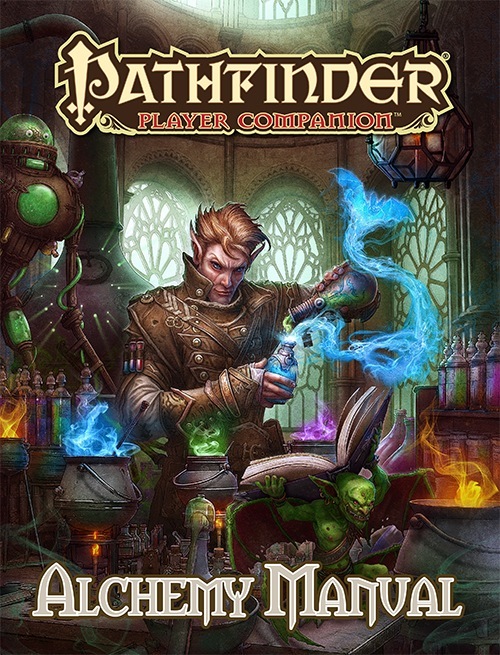
Third
Edition Dungeons & Dragons introduced the Alchemy skill to the
game, and along with it a few alchemical items that characters could
buy and use while adventuring (earlier editions had alchemical items
but didn’t really have codified rules for them). The 3.5 rules
changed the skill to be a branch of the Craft skill, but otherwise
retained the same structure. Over the years, as the game added more
and more options (new feats, spells, etc.), alchemy was strangely one
of the neglected areas. Very few new alchemical items were added to
the game and the ones that were there from the start were
low-powered, making alchemy something generally only employed by
low-level characters before they gained access to high-level spells
and other powers. Pathfinder, however, has been gradually adding more
and more alchemy to the game. Ultimate Equipment has a sizeable
section for alchemy and numerous other books have added a few items
(including more powerful ones) here and there. The recent Undead Slayer’s Handbook, for
example, has quite a few new alchemical items in its pages. Most
notably, the Advanced Player’s Guide added an entire
class devoted to alchemy: the alchemist. This has made alchemy a much
more prevalent part of Pathfinder than it was before. Nevertheless,
alchemy is still an area that has not seen as much new material for
it as other areas like feats, spells, archetypes, and traits. But
now, the Alchemy Manual
helps to redress that balance a little.
In
a game awash with so many options that most will rarely, if ever, see
use, the Alchemy Manual
stands out as a book that is likely to see a lot
of use. A first glance, it may seem like a book for the alchemist
class—and in a way, it is, as alchemists will certainly get a lot
of use out of it. However, one of the nice things about alchemy is
that it can be picked up, learned, and used by just about any
character. Craft is a class skill for virtually every class, and
alchemical items don’t have limits on who can use them, unlike many
magic items, even though they often create near-magical effects. The
Alchemy Manual focuses
on the skill, Craft (alchemy) and the items produced by that skill,
and not on things like alchemist discoveries, which are limited to
the alchemist class. In fact, some people might be a little surprised
to discover that there isn’t a single new alchemist discovery in
this book. This is a book usable by everyone, and that’s one of the
best things about it. It has a huge number of new alchemical items
(broken down into different styles of alchemy) along with a few new
feats and tools to expand the versatility and options available to
users of the Craft (alchemy) skill.
Monday, 5 May 2014
Undead Slayer's Handbook

Undead
are an iconic part of fantasy roleplaying. There are few campaigns
that won’t, at some point or other, include a few undead, be they
mindless skeletons and zombies or more powerful undead like vampires
and liches. Many campaigns will feature undead quite frequently and
may even focus on them. The PCs may consist of vampire hunters,
carefully stalking the creatures of the night. Or perhaps they seek
out restless spirits like ghosts and spectres in order to send them
to their proper rest. The Undead Slayer’s Handbook is a book that
is geared specifically towards these kinds of characters. It provides
tools and options for Pathfinder characters who hunt the undead.
While
the Undead Slayer’s Handbook
is a bit of a niche product, it still has a fairly broad scope, as
undead are bound to show up at some point in just about any campaign.
This makes the book more widely usable than a book like the
Dragonslayer’s Handbook.
Even in campaigns focused on dragons, PCs aren’t likely to
encounter a lot of them. However, even in campaigns that aren’t
focused on undead, PCs are still likely to encounter quite a few
undead creatures, from zombie minions to vampire overlords.
Thursday, 1 May 2014
Inner Sea Gods
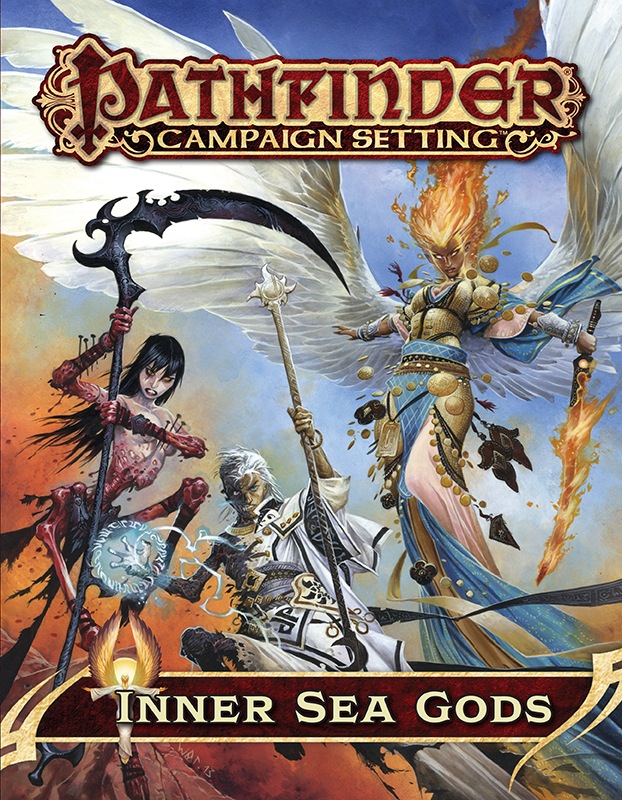
The
gods and their followers make up an important part of any fantasy
campaign setting. They provide the myths and legends of the world,
and their religions help define the ways the people of the world go
about their lives from day to day, month to month, and year to year.
In Pathfinder and many other games, the gods also provide their most
favoured servants with power, often in the form of spells, but also
other unique abilities as well. Thus, having a well-defined pantheon
of gods is integral to creating a coherent setting.
The
gods of the Pathfinder Campaign Setting world of Golarion have been
developed over several years now, beginning as just a list of names
and domains in the original Rise of the Runelords Player’s Guide,
but were then gradually expanded upon with occasional articles
dedicated to individual deities appearing in Pathfinder Adventure Path volumes. It
wasn’t long before they got a book dedicated to them in Gods and Magic. But that book,
at 64 pages, could only hold so much. It’s an overview, really, and
as the campaign world has expanded and developed, that book has
become less and less useful. There is far more detailed information
available in the aforementioned Pathfinder Adventure Path
articles and books like Faiths of Purity, Faiths of Balance, Faiths of Corruption, and Faiths & Philosophies. But
one problem with all this information is that it is scattered across
more than twenty different books, which can make it difficult to find
when needed.
Inner Sea Gods, a massive
336-page hardcover tome, helps rectify that problem and introduces
lots of new material for both GMs and players. To be fair, some
people may see a lot of the material in this book as a retread. It
does compile the Pathfinder Adventure Path
articles on the 20 core gods of the Inner Sea Region into one place,
and that fills up the entire first half of the book. The information
on the other gods is also mostly compiled from other sources, leaving
about a third of the book to completely new material (mostly game
options like new feats, spells, traits, and prestige classes).
However, the book has done more than just compile the older
information. It has also revised that information to bring it in line
with the way the setting has developed and even changed since the
material was first published. Gone are paladins of Asmodeus (well,
actual lawful good paladins, that is; people claiming
to be paladins of Asmodeus are still very much present) and Erastil’s
misogyny, and numerous other small revisions can be found by those
who look closely enough.
Inner
Sea Gods is really quite a
remarkable book. The interior layout is absolutely gorgeous. More
important than that, the content is full of flavourful information
that will leave GMs with tons of material to create new NPCs and
plots with. And although there’s a huge amount of information to
absorb, it’s a fun and entertaining read from beginning to end.
April Round-Up, Star Wars Episode VII, and Never-Ending Cosmos Praise

So,
the big news in April came just a couple days ago with the
announcement of the cast for Star Wars Episode VII. I must admit
I’m unfamiliar with most of them except the original trilogy cast
(obviously), Andy Serkis and Max von Sydow. However, I couldn’t
help noticing (as did others)
that the new cast contains lots of men (mostly white men at that with
one token black guy) and one woman. Sticking to tired old formulas,
Star Wars? So much for
progress. Still, following the fact that lots of people noticed this,
it was revealed that there is
still another “substantial” role to fill. That’s good news, I
suppose. I do have to wonder, though, just how substantial this role
actually is, given that they didn’t feel the need to wait for it to
be cast before announcing the other actors playing substantial roles.
Time will tell, I suppose, but let's be honest, even two is not a great number. Women do make up 51% of the population after all.
Honestly,
even though I was a Star Wars fanatic
as a child and well into my young adult years, it just doesn’t hold
the same sense of wonder for me that it once did. Personally, I’m
far more excited about the ongoing series of Cosmos!
It has made a much greater impact on me this month, as can be seen
with my ongoing coverage of it on this site. I was starting to fall
quite a bit behind in my episode reviews, but managed to get
completely caught up in the last week. Altogether, this month saw
reviews of episodes four,
five,
six,
seven,
and eight.
I eagerly look forward to the remaining five episodes. Although it’s
not exactly Cosmos,
here’s Neil deGrasse Tyson giving a kick-ass answer to a rather stupid question about whether genetics plays any role in the lack of
women in science:
In
gaming, April 5th was International Tabletop Day, and Wil
Wheaton’s Geek & Sundry series, Tabletop
began a campaign to raise funds for its
third season. They’ve already made their initial goals and will be
producing a 20-episode season. However, if they reach $1 million
total, they will also produce a spin-off series based on roleplaying
games. There are only ten days left, but they are very close to that
million dollar mark. Tabletop’s
a great show, and I would really like to see the RPG spin-off. Let’s
hope they’re successful!
I
only wrote one Pathfinder review this month: the opening to the new
Mummy’s Mask
adventure path, The Half-Dead City.
The lack of further reviews is down to the fact that next one is of
the massive 332-page hardcover, Inner Sea Gods. That took
awhile to read through, but I’m done now and my review should be up
within the next few hours.
This
month, I also discovered the wonderful documentary The Delian Mode, about Doctor
Who composer Delia Derbyshire.
It’s a must-see for all Doctor Who
and electronic music fans. Finally, I also made a brief post about
the short video, “Stone”.
Here’s
to a great May!
Subscribe to:
Posts (Atom)