Thursday, 29 June 2017

Doctor Who - The Eaters of Light


Many people have written for Doctor Who over the years. Some have penned only a single script and, for various and sundry reasons, have never written another. Some have written two or three, and still others have written many. Robert Holmes and Terrance Dicks were among the most prolific writers of the classic Doctor Who series. Since the show’s return in 2005, there have also been several writers to write many episodes, including Mark Gatiss, who wrote this year’s “Empress of Mars”. Russell T Davies wrote many episodes during his time as showrunner, and Steven Moffat wrote several episodes during Davies’s time and has written numerous since taking over as showrunner.

However, until now, there has been no writer to have written for both the original and revived series. Rona Munro is the first to fill this role. Munro wrote the final story of the original series’ run, 1989’s “Survival”. This year, she has returned to Doctor Who with the delightful episode, “The Eaters of Light”.

In several of my reviews for this year’s episodes, I have commented on Series 10 being the most consistently good series in some time. To be honest, over the previous two episodes, I was beginning to waver on that opinion. “The Lie of the Land” was frustrating, and “Empress of Mars”, while a decent episode, was not all that great either. “The Eaters of Light”, however, has restored my faith in the series. It returns to delivering what the early episodes of this series delivered: excitement, humour, great characters, an engaging plot, and everything needed for a great Doctor Who episode.

SPOILERS FOLLOW

Wednesday, 28 June 2017

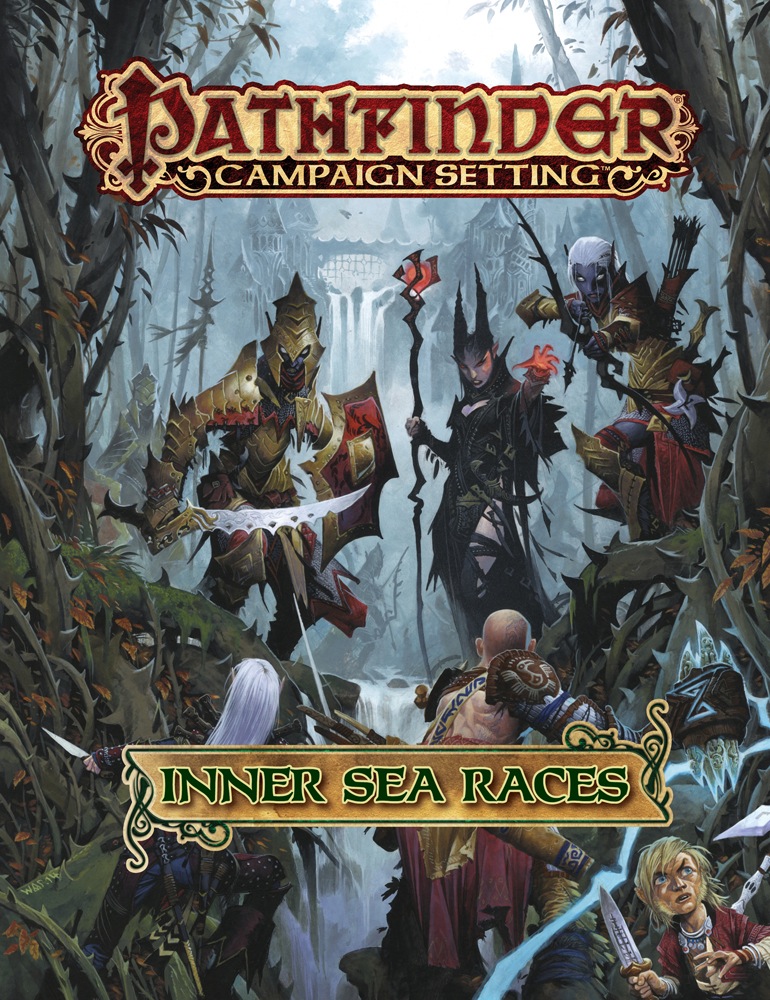
Inner Sea Races


The Pathfinder Campaign Setting world of Golarion is a diverse world, full of numerous different races, cultures, and ethnicities. This goes beyond just the core races of humans, dwarves, elves, gnomes, half-elves, half-orcs, and halflings. There are tieflings, aasimars, goblins, ratfolk, and more. There are even androids and aliens from other worlds. As the setting has expanded over various books, more and more of these races have received expanded detail, from cultural information to options to play them as player characters. But much of that information is scattered across numerous different books, making it sometimes hard to keep track of it all.

Inner Sea Races brings much of this information into one spot. In doing so, it takes the opportunity to revise and expand on that information, becoming the definitive book on the varied peoples of the Inner Sea region of Golarion. And it’s chock full of tons of useful information that will help bring both PCs and NPCs alike to life.

Inner Sea Races is a 256-page hardcover book. In layout, it’s arranged similarly to the Advanced Race Guide, in that the chapters are broken down based on how common the races are. However, the similarities mostly end there. Whereas Advanced Race Guide is a book of primarily game mechanics options with a bit of generic flavour text for the races it covers, Inner Sea Races focuses almost entirely on flavour text, covering such things as history, society, faith, and relations between races. In fact, there is no mechanical information at all in the first three chapters. The fourth chapter does introduce some new mechanical options, but this is a relatively small portion of the book. People looking for a vast array of new character abilities may well be disappointed with Inner Sea Races, but people, like myself, looking for more flavour text will likely be happier.

Tuesday, 27 June 2017

Doctor Who - Empress of Mars


The Ice Warriors have an unusual position on Doctor Who. Pretty much any list of iconic Doctor Who monsters will include the Ice Warriors on it, generally around position four (after the Daleks, Cybermen, and Sontarans), yet the Ice Warriors haven’t actually appeared in all that many stories—only four in the original series (the last of which was “The Monster of Peladon” in 1974) and one in the new series (“Cold War” in Series 7). It’s pretty telling that a group that has had so few appearances has made such an impact. And I think it’s with good reason. In my review of “Cold War” a few years ago, I briefly explained why they are one of my favourite Doctor Who monsters, the primary reason being that they have more depth than most of the show’s aliens.

It was pretty much inevitable that the Ice Warriors would eventually return to Doctor Who again, especially since they are also one of the favourite monsters of Mark Gatiss, who has written and continues to write many Doctor Who stories, including “Cold War”. In “Empress of Mars” (again by Gatiss), the Ice Warriors are encountered on their home planet of Mars for the first time (all previous Ice Warrior stories have been on Earth or Peladon), and this time, the humans are the invaders.

Truth be told, “Empress of Mars” is not an incredible episode, but it is a decent one. It has all the elements that go into making a good Doctor Who story, but doesn’t really take any risks that might elevate it to the level of a great Doctor Who story. Nevertheless, it’s fun, entertaining, and an enjoyable way to spend 45 minutes.

SPOILERS FOLLOW

Doctor Who - The Lie of the Land


There are good Doctor Who episodes and bad ones, great ones and terrible ones. Most are a mixture of these qualities, with the good generally outweighing the bad, but with a few the other way round. Every once in a while, though, an episode comes along with a frustrating mixture of good and bad and everything in between, making it extremely difficult to provide an overall opinion of the episode. Even averaging it all out to “mediocre” doesn’t truly convey the experience of watching the episode.

“The Lie of the Land” by Toby Whithouse is one such episode. There is much about the episode that is really good—individual moments that thrill and entertain, a compelling concept and setting, some great performances, and more. Yet there is also so much that just doesn’t hold together—scenes that don’t add much to the overall story, a compelling setting that’s never really explored, and more. As the conclusion of a three-part epic, the episode falls completely flat. The story begun and developed in “Extremis” and “The Pyramid at the End of the World” suddenly seems superfluous and those two episodes kind of pointless, as “The Lie of the Land” doesn’t really do anything to build on them, particularly in developing the Monks, who in this episode become relatively generic villains and lose all that made them work so well in the previous two.

SPOILERS FOLLOW

Tuesday, 30 May 2017

Doctor Who - The Pyramid at the End of the World


Last week’s episode, “Extremis”, introduced us to Doctor Who’s latest monstrous alien species, beings we don’t really know the name of yet, but referred to as the monks for their robed appearance. In “The Pyramid at the End of the World”, we begin to see their plans unfold, but it’s a very different style of alien invasion compared to what we’ve seen before—but the monks are very different aliens to what we’ve seen before as well.

What results is a compelling and often tense episode that has many of the markings of a classic. Unfortunately, it also has a number of flaws that hold it short of hitting that mark, including several rather wooden characters, and a few too many contrivances to allow plot events to happen than are easily believable. There are some great concepts and moments, though, and it certainly leaves me eager to see more.

SPOILERS FOLLOW

Monday, 29 May 2017

Doctor Who - Extremis


Note: Although the episode after “Extremis” has already aired at the time of posting this review, at the time of writing, I have not yet watched “The Pyramid at the End of the World”. This review is written without knowledge of what comes next.

I mentioned in my review of the previous episode, “Oxygen”, that I’ve found Series 10 to be the most consistently good series of Doctor Who in a long time. This opinion has definitely not changed. However, one of the things I’ve particularly liked about the earlier episodes of the series is that they have stopped focusing heavily on the show’s past and instead have started looking forward to new ideas and new journeys. In “Extremis”, the show does start looking to the past again. This isn’t necessarily a bad thing, and in fact, Doctor Who should never completely disregard its past; looking to the past ought to happen from time to time.

“Extremis” handles this very well. Its use of the past helps to build its future. However, “Extremis” is also a somewhat less accessible episode to newer viewers than the previous five have been. Considering that this series has been deliberately structured to be an ideal “jumping-on” point for new viewers, I do wonder if “Extremis” might be a bit of a misstep—not a big one, but a little one. It will depend a lot on what happens in future episodes.

Whether it is or not, “Extremis” is still an excellent episode that I enjoy immensely. It has a wonderfully foreboding atmosphere, and introduces a creepy new set of monstrous aliens. It has a more complex plot than the previous episodes of the series, but everything ties together well and events are fully understandable by the end. There are also some interesting developments in the series’ arc. Overall, “Extremis” continues the high quality of Series 10 so far.

SPOILERS FOLLOW

Saturday, 20 May 2017

Dirty Tactics Toolbox


“Dirty fighting” is a bit of a nebulous concept. In general, it tends to mean using techniques that are less than honourable—tricks, ambushes, poison, and so on. Yet what one person considers honourable isn’t necessarily the same as what another person does, and truth be told, if you’re in a fight to kill, is anything truly honourable or dishonourable?

Dirty Tactics Toolbox talks briefly about the “Ethics of Fighting Dirty”, pointing out that dirty fighting isn’t necessarily evil, and that context and culture can play a large role in determining what is considered dirty fighting. The book as a whole doesn’t make any judgements on whether any particular methods of dirty fighting are good or evil (even poison use), and instead merely focuses on offering various new options for Pathfinder characters to make use of.

Dirty Tactics Toolbox follows in the vein of its predecessor “Toolbox” books: Ranged Tactics Toolbox and Melee Tactics Toolbox. And much like those two other books, I have the same basic issues with it. While it’s a perfectly functional book, there’s not a lot in it that really stands out and is memorable when compared with the vast amount of other options already available in the game. That said, I do think it edges out the previous two books by a small margin by having a few more things that did catch my attention and a few more instances of nicely integrated world flavour.

Friday, 19 May 2017

Giantslayer - The Hill Giant's Pledge


One thing I really like is when adventures provide dynamic locations—places that aren’t always exactly the same no matter when the PCs arrive. The monsters and NPCs move around and interact with themselves, and not just with the PCs. They are places that make the PCs feel like part of a living world, even if that world is full of enemies that the PCs must fight.

Of course, good gamemasters can make any adventure site be this way, but some adventures are better than others at assisting GMs in this regard. Just from reading the text, the locations come alive, full of characters with motivations causing things to happen. The second part of the Giantslayer Adventure Path, The Hill Giant’s Pledge by Larry Wilhelm is such an adventure. It contains a wide assortment of interesting NPCs (both villains and allies), each with fairly detailed back-stories and motivations. It makes for a wonderfully dynamic adventure that can play out in a multitude of different ways depending on what the PCs do. There are a couple of inconsistencies here and there that don’t work quite so well, but on the whole, it’s a very good continuation of the adventure path.

SPOILERS FOLLOW

Monday, 15 May 2017

Doctor Who - Oxygen


It’s been a long time since I was last so pleased with a Doctor Who series. I was happy with much of Series 8 and 9, both of which I continue to feel were significant improvements over Series 5 through 7, but nevertheless, they had their ups and downs. There were some excellent episodes, like “Mummy on the Orient Express” and “Heaven Sent”, but also some really bad ones, like “Kill the Moon” and “In the Forest of the Night”, along with more than a few mediocre ones. Series 10, however, has been the most consistently good series since Steven Moffat took over as showrunner.

It’s probably important that I clarify that last statement with so far. There’s still a little over half the series to go and it is entirely possible that the remainder could be horrible—but I don’t expect it to be. There may well be a weaker episode or two, but the strength of the episodes so far is very encouraging for those to come. I have high hopes that Series 10 will be a very strong series when looked at as a whole.

The fifth episode, “Oxygen”, perfectly demonstrates the qualities that have helped make this series so good: strong characterisation of the leads, better pacing that allows the stories to develop more organically (albeit with some slightly rushed endings), and not dwelling heavily on the show’s past. On top of that, it also throws in some very effective scares, has a nice political message, and also manages to be one of the most scientifically accurate Doctor Who episodes (Doctor Who will never be hard science fiction, but this episode edges closer than most). In true Doctor Who fashion, it even throws in some comedy along the way. It is, without a doubt, a great episode to watch, and I can easily watch it over and over.

SPOILERS FOLLOW

Saturday, 13 May 2017

Iron Gods Poster Map Folio


Like most other map folios, the Iron Gods Poster Map Folio comes with three full-colour poster maps suitable for use with the Iron Gods Adventure Path, but also usable with other campaigns set in Numeria.

There is a map of Numeria itself. As is standard for country maps in these folios, it is done in the style of a map the PCs might actually use in-world and can be freely shown to players. It is beautifully illustrated with pictures of monsters and very setting-appropriate robots. I am also happy to say that, unlike the map of Osirion in the Mummy’s Mask Poster Map Folio, this one has labels of cities, towns, and other major landmarks like Silver Mount. This makes it much more useful in actual play and not just something pretty to look at.

The other two maps detail Starfall, the capital city of Numeria, and Torch, the town Iron Gods begins in. The map of Starfall is rather uniform in colour, (mostly shades of brown) making it less interesting to look at, but it remains useful for gameplay. There is a lot of brown on the map of Torch as well, but the town’s smaller size means more variation and detail can be included, making it not quite so uniform as Starfall.

Overall, the maps are definitely worth it for any campaign set in, or passing through Numeria.