Showing posts with label Pathfinder Campaign Setting. Show all posts

Thursday, 8 November 2018

Giantslayer Poster Map Folio


I can never have too many maps in my games. Particularly the big ones. I love unfolding them, laying them out on the table, and pointing to one location or another. I love the context they provide for where things are happening in the game world. And sometimes, they’re just pretty to look at. As such, I appreciate the map folios that come out for each adventure path. They help me get my fix of pointing at maps. They’re also generally useful for any games set in the same region, not just the adventure paths in their name.

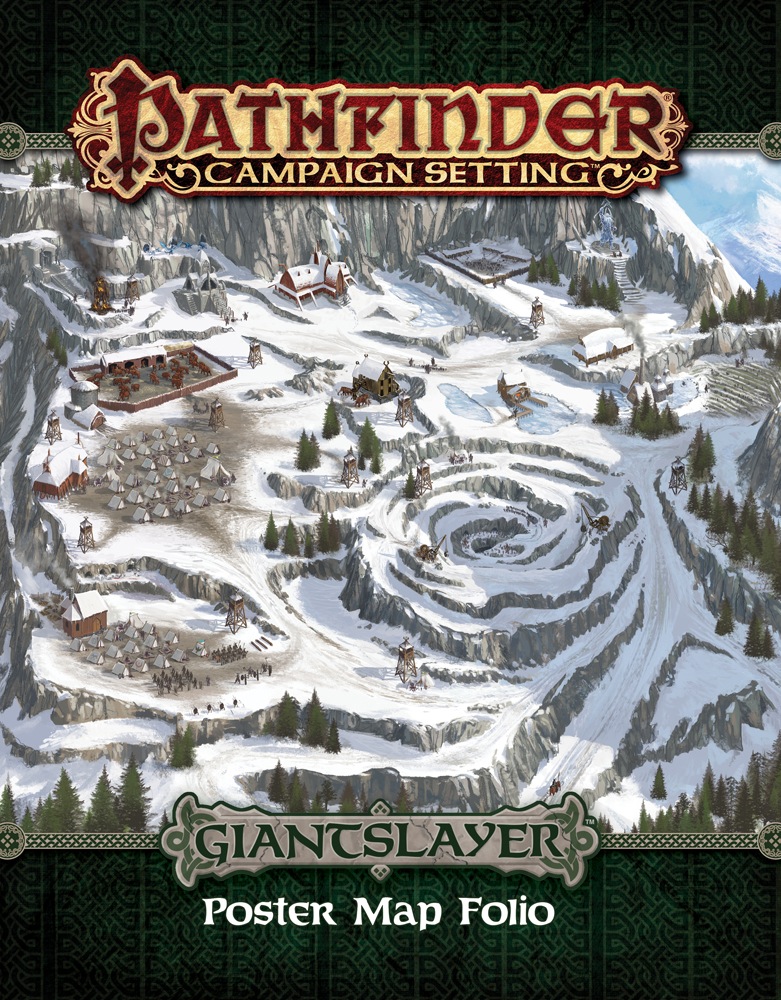
The Giantslayer Poster Map Folio is no exception. Like most other adventure path map folios, it comes with three fold-out poster maps, each showing a location relevant to the Giantslayer Adventure Path. The first is a map of Trunau, the town that the adventure path starts in, and where the player characters might call home. The second is a map of the Mindspin Mountains, the region where the adventure path expands into. Trunau is located towards the northeast corner, and from there, it’s possible to trace out the route the remainder of the adventure path takes. Both these maps are useful, functional, and attractive.

The third map in an adventure path map folio tends to be a more artistic piece. Often, it’s a map of a country or region done in the style of a map the characters in the game might actually purchase and use, rather than one designed for gaming purposes. In this folio, it is a map of Skirgaard, the location of the fourth adventure. In this case, it’s more than just a map; it’s also an illustration of the entire village. Skirgaard is a small enough location that it’s possible to not just show where each individual location is, but to also sketch out every location in detail, complete with people moving about and smoke rising from chimneys. The map shows the village from the vantage point of a little bit above and to the south. When PCs arrive at the village, GMs no longer need to describe what they see. Instead, they can just show the map and say, “This is what you see.” The map is breathtakingly beautiful to look at, and I think it’s probably my favourite of all the artistic maps in all the adventure path map folios.

The Giantslayer Poster Map Folio makes a great addition to a Giantslayer campaign, and to any campaign set in Trunau and/or the Mindspin Mountains.

Tuesday, 31 July 2018

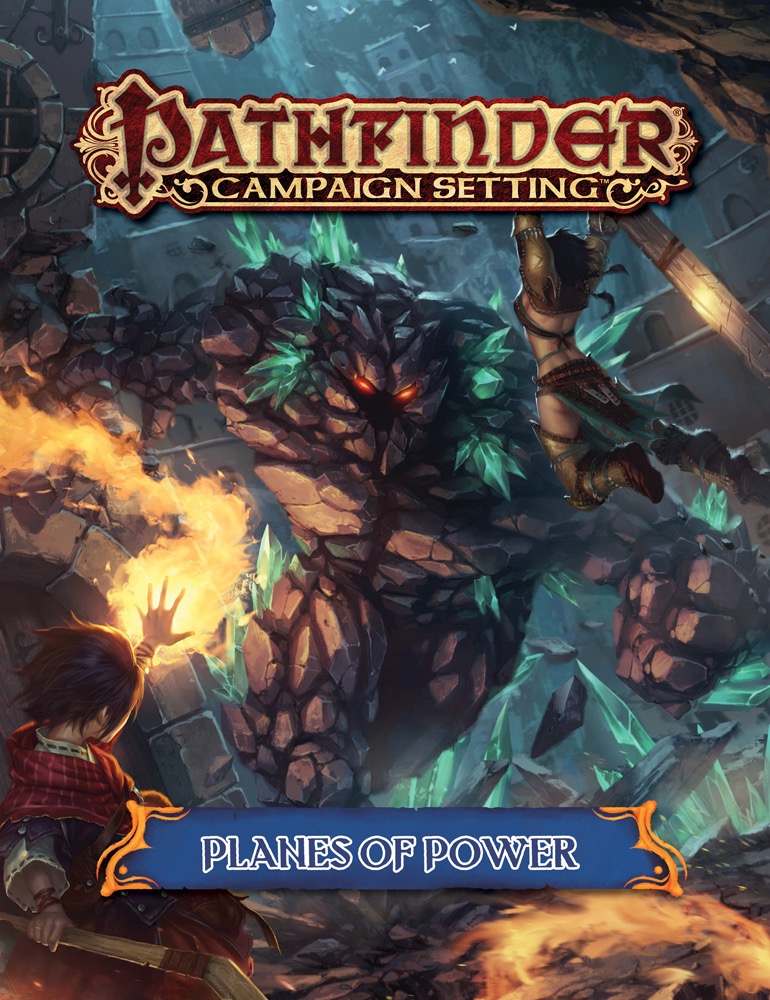
Planes of Power


Fantasy roleplaying games allow an escape from reality. They allow us to play out stories with magic, elves, and dragons that could never happen in the real world. Yet they retain elements of the real world, often taking aspects of real world history and cultures to inspire the peoples and societies that populate them. These elements allow the game to retain a certain sense of familiarity, and a certain sense of reality amidst the fantasy.

But sometimes, you just want to abandon reality altogether, get rid of the familiar as much as possible, and create something truly different. This can be through travel to other worlds or even other planes. Planar travel has been a mainstay of roleplaying since its earliest days. It’s often something only embarked upon by high-level characters who have acquired the greater powers needed to make the jump from one plane to another, but it doesn’t have to be. The old 2nd Edition Dungeons & Dragons campaign setting, Planescape made PCs natives of other planes and incorporated plane-hopping right from first level.

The Pathfinder Campaign Setting first outlined its planar structure in the old Pathfinder Chronicles: Campaign Setting book (later updated as Pathfinder Campaign Setting: The Inner Sea World Guide). The information in that book was later expanded upon in The Great Beyond. But even that book could only provide the barest details. The planes are more than just other worlds; they are entire other universes with enough space in each one to hold millions of entire campaign settings.

Planes of Power is a more recent book that takes a much closer look at just four of the many planes that make up the Great Beyond—specifically the Elemental Planes of Air, Earth, Fire, and Water. Of course, this book can still only scratch the surface of these planes, but it is able to provide enough of a backdrop to whet GMs’ creative juices and allow them to expand beyond what’s presented.

Tuesday, 10 July 2018

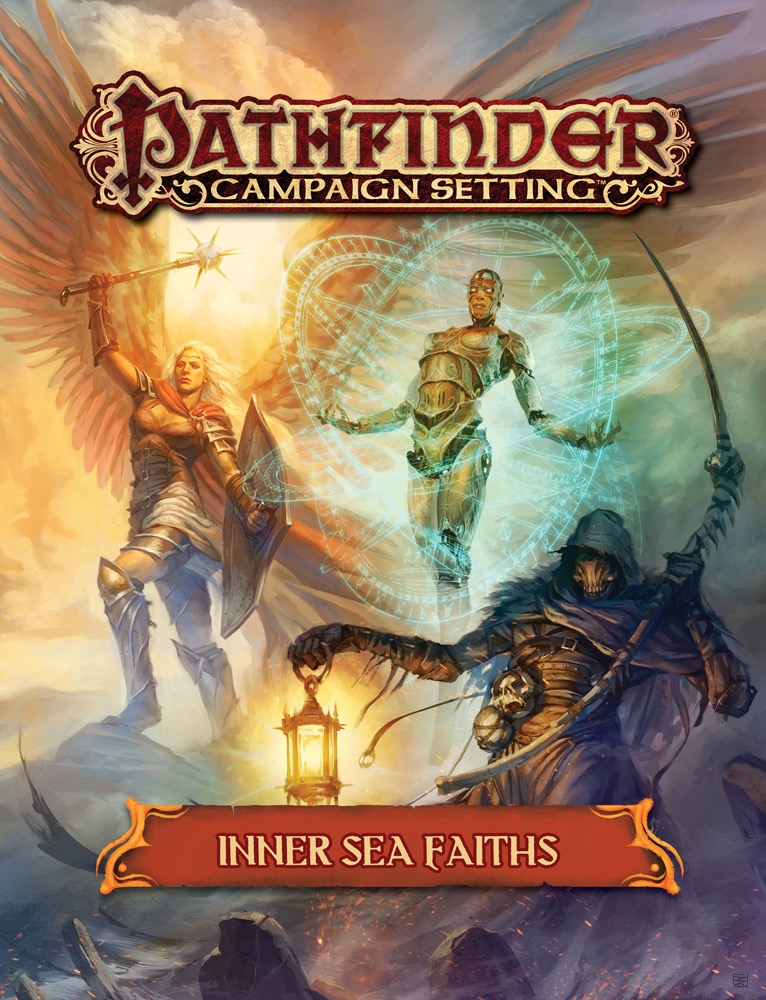
Inner Sea Faiths


Clerics have always been one of my favourite classes. I like getting into the mindset of people who devote their lives to serving greater powers. As such, I also love books that focus on those powers—what their religions are like and what drives their followers. One of the most-used Pathfinder books in my games (apart from the central rulebooks) is Inner Sea Gods, which provides detailed information on the core 20 gods of the Golarion setting (along with additional character options).

However, Golarion has considerably more than just 20 gods. Inner Sea Gods contains details on many of the others, but no book has unlimited space, so these additional details are understandably brief—half a page at most, and often no more than a single paragraph. Some of these additional gods have received more detailed write-ups in other sources, such as volumes of Pathfinder Adventure Path, but ever since Inner Sea Gods came out, I’ve hoped that there would eventually be another book that would collect together these other gods into one place.

Inner Sea Faiths is just such a book. It provides details on 15 of the lesser-known gods of Golarion, such as Brigh, Hanspur, Kurgess, and Sivanah. All 15 are given write-ups in the same style as the ones for the core 20 gods in Inner Sea Gods. Inner Sea Faiths is not as big a book as Inner Sea Gods. The write-ups are 6 pages long each instead of 8, and it doesn’t contain any new prestige classes, magic items, spells, etc. It’s also not a hardcover book. However, it is still a bigger book than most in the Pathfinder Campaign Setting line—96 pages long instead of the standard 64.

Wednesday, 28 June 2017

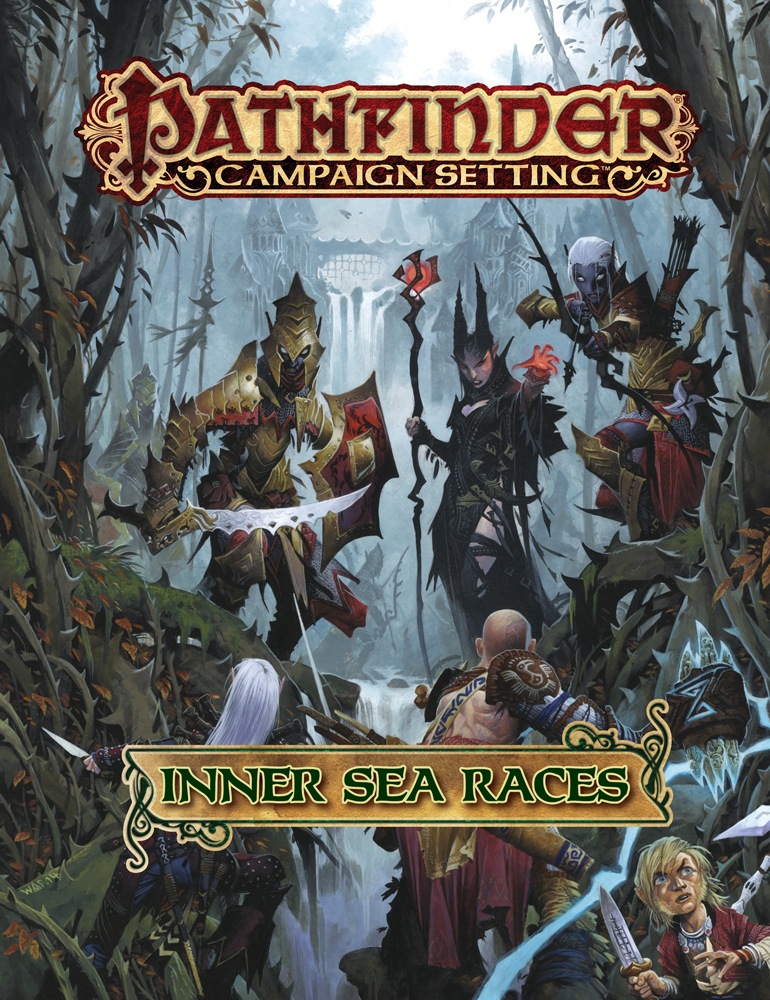
Inner Sea Races


The Pathfinder Campaign Setting world of Golarion is a diverse world, full of numerous different races, cultures, and ethnicities. This goes beyond just the core races of humans, dwarves, elves, gnomes, half-elves, half-orcs, and halflings. There are tieflings, aasimars, goblins, ratfolk, and more. There are even androids and aliens from other worlds. As the setting has expanded over various books, more and more of these races have received expanded detail, from cultural information to options to play them as player characters. But much of that information is scattered across numerous different books, making it sometimes hard to keep track of it all.

Inner Sea Races brings much of this information into one spot. In doing so, it takes the opportunity to revise and expand on that information, becoming the definitive book on the varied peoples of the Inner Sea region of Golarion. And it’s chock full of tons of useful information that will help bring both PCs and NPCs alike to life.

Inner Sea Races is a 256-page hardcover book. In layout, it’s arranged similarly to the Advanced Race Guide, in that the chapters are broken down based on how common the races are. However, the similarities mostly end there. Whereas Advanced Race Guide is a book of primarily game mechanics options with a bit of generic flavour text for the races it covers, Inner Sea Races focuses almost entirely on flavour text, covering such things as history, society, faith, and relations between races. In fact, there is no mechanical information at all in the first three chapters. The fourth chapter does introduce some new mechanical options, but this is a relatively small portion of the book. People looking for a vast array of new character abilities may well be disappointed with Inner Sea Races, but people, like myself, looking for more flavour text will likely be happier.

Saturday, 13 May 2017

Iron Gods Poster Map Folio


Like most other map folios, the Iron Gods Poster Map Folio comes with three full-colour poster maps suitable for use with the Iron Gods Adventure Path, but also usable with other campaigns set in Numeria.

There is a map of Numeria itself. As is standard for country maps in these folios, it is done in the style of a map the PCs might actually use in-world and can be freely shown to players. It is beautifully illustrated with pictures of monsters and very setting-appropriate robots. I am also happy to say that, unlike the map of Osirion in the Mummy’s Mask Poster Map Folio, this one has labels of cities, towns, and other major landmarks like Silver Mount. This makes it much more useful in actual play and not just something pretty to look at.

The other two maps detail Starfall, the capital city of Numeria, and Torch, the town Iron Gods begins in. The map of Starfall is rather uniform in colour, (mostly shades of brown) making it less interesting to look at, but it remains useful for gameplay. There is a lot of brown on the map of Torch as well, but the town’s smaller size means more variation and detail can be included, making it not quite so uniform as Starfall.

Overall, the maps are definitely worth it for any campaign set in, or passing through Numeria.

Friday, 12 May 2017

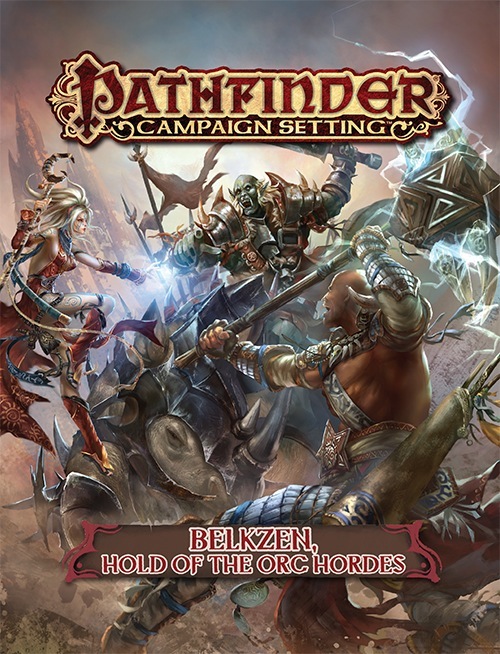
Belkzen, Hold of the Orc Hordes


Orcs are a staple of fantasy. Yet their presence tends to be as little more than background fodder. Tolkien’s orcs serve as little more than “faceless” adversaries to be killed in large numbers. Adversaries similar to orcs appear throughout fiction—from Star Wars’ Storm Troopers to Doctor Who’s Daleks—enemies who have little in the way of individual personalities and are often almost literally faceless (hidden behind a mask or within some sort of casing). This lack of individuality allows them to die in large numbers without the audience feeling sympathy for them and allowing the protagonists to feel no guilt.

Yet while these faceless adversaries might allow for some impressive action sequences, ultimately they can get somewhat repetitive and just a little boring. It can make for a much more compelling story when the adversaries have a little more depth and exist as more than just corpses-to-be. As such, I approve when roleplaying games provide more in-depth background to their monsters.

Belkzen, Hold of the Orc Hordes should have been an opportunity to do this for orcs in Pathfinder, and to be fair, it makes a couple tokens attempts to do so. However, on the whole, it misses out on the opportunity, instead focusing mostly on describing locations and adventure sites, many of which happen to have orcs in them. It does little to give the orcs any real character beyond violent killers or to differentiate one orc tribe from another. By the end of the book, orcs remain pretty much as faceless as they’ve always been, just fodder waiting for for the PCs to kill them.

Wednesday, 25 January 2017

Qadira, Jewel of the East


As much as I love the Pathfinder Campaign Setting, I have had a recurring criticism of many of the books describing the world. While I generally come away from the books knowing a great deal about what it’s like to adventure in the particular land being described, I often don’t know much about what it’s like to live there. Of course, the adventuring part is very important. The game is all about adventuring and the player characters themselves are generally referred to as adventurers. As such, the adventuring part is actually crucial.

Actual game play spends less time on day-to-day living. In fact, these sorts of things are often skimmed over. If they weren’t, it would take interminably long to play any campaign. For this reason, people might be inclined to think that information on what day-to-day life is like in the world would be less important—maybe even unimportant—in a setting book. I argue quite differently. While these are background details, they are also the kinds of details that bring a setting alive. Small details like the food the characters have for dinner, the kinds of clothes locals wear, or the customs they have for greeting strangers help to paint a picture of where all these adventures take place. They allow the players to better empathise with the world, and that in turn makes it all the more satisfying to the same players when their characters help to save that world and the people in it.

Yet Pathfinder Campaign Setting books often skimp on these details of daily life. An example I’ve commented on before is that several books contain the information that Prophets of Kalistrade have strict dietary restrictions, yet none of these books ever say what the restrictions actually are. So when a book comes along that breaks with this mould, I’m quick to praise and draw attention to it. Qadira, Jewel of the East by Jessica Price is such a book.

Thursday, 12 January 2017

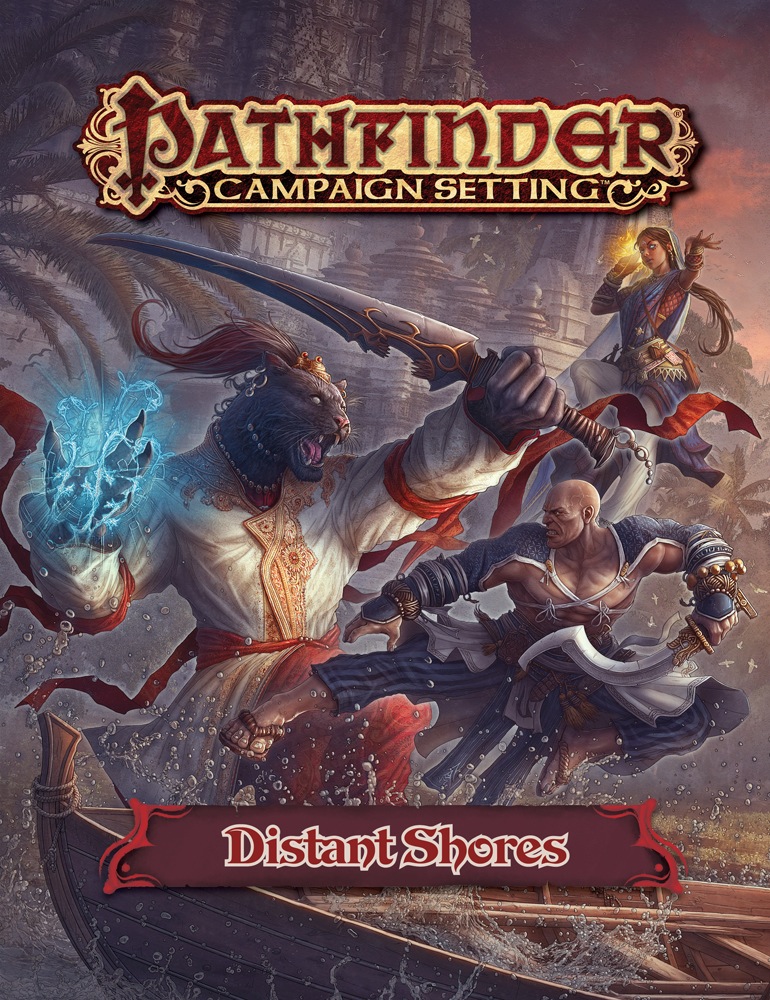
Distant Shores


The Pathfinder Campaign Setting is focused primarily on the Inner Sea Region. This includes the continent of Avistan and northern portion of the continent of Garund. The majority of lands that have been detailed to date lie in this region. However, this amounts to a relatively small portion of the entire world of Golarion. Avistan is one of the smaller continents and while Garund is a much larger continent, only a small portion of it lies in the Inner Sea Region. There are several other continents as well. One of these, Tian Xia, has received an overview treatment in Dragon Empires Primer and Dragon Empires Gazetteer.

There have been some brief forays into other lands. The Hungry Storm, the third part of Jade Regent, for example, contains information on the Crown of the World, Golarion’s north polar region, which connects Avistan to Tian Xia, and the Inner Sea World Guide has brief overviews of all the continents on Golarion. Distant Shores, one of the most recent books to look beyond the Inner Sea Region, examines six very different cities from various different parts of the globe, and offers tantalising hints about the lands that they are part of.

Paizo has always strived for diversity in its campaign setting, which is a great thing. Numerous different real-world cultures, races, and ethnicities have analogues on Golarion. However, the fact remains that most of the cultures of the Inner Sea Region have their roots in white European cultures. Moving beyond the Inner Sea provides the opportunity to tip the balance slightly away from that, and this is exactly what Distant Shores does.

Friday, 18 March 2016

Ships of the Inner Sea


One of the great things about fantasy games like Pathfinder is the sheer number of different styles of adventuring that are possible. There's a lot more than just dungeons and dragons (pun intended). You can explore the wilderness, journey through tangled jungles, climb towering mountains, get involved in politics, lead armies and overthrow empires, and more. The opportunities are endless. One of the many environments ripe for adventure is the open sea, where you can be travellers to distant lands, merchants carrying goods to various ports, or pirates who plunder what the merchants are carrying. Indeed, shipbound adventures can be amongst the most exciting and fun.

Ships of the Inner Sea provides material for gamemasters to use in seafaring campaigns. It describes seven ships that sail the Inner Sea, including details of their layouts, histories, and crews. Some of the ships and crews might be allies of the PCs, or the PCs might even join their crews; other ships contain enemies and villains to fight. All the ships make for interesting encounters, either one-off or recurring. Ships of the Inner Sea doesn't just have to be for seafaring campaigns either. Even campaigns that are mostly landlocked may spend some short periods at sea as the player characters travel from one location to another, and such an occasion could also be a perfect opportunity for an encounter with one of the ships from this book.

I generally like these kinds of sourcebooks as they provide material that GMs can draw on when they need something last-minute, while also being supplements they can build entire campaigns around. For the most part, Ships of the Inner Sea doesn't disappoint. There's a good variety in the types of ships presented and all of them contain enough ideas and adventure seeds to keep any group occupied for some time. It's certainly a resource I will turn to if I run a seafaring campaign at some point in the future.

Thursday, 21 January 2016

Lost Treasures


Treasure is an important part of Pathfinder games. Players often get very attached to their characters' equipment—enough so that being the target of mage's disjunction, a spell that destroys magic items, is often considered a worse fate than dying. At high levels, death is not that hard to reverse in Pathfinder. Replacing powerful magic items can be much more difficult. It is a bit unfortunate that acquiring monetary wealth is such a principal motivator for PCs, but the fact is, the ownership of magic items is tied into the very mechanics of the game. PCs need wealth just to keep up. Fortunately, there is lots of treasure to be gained on adventures.

Unfortunately, when treasure is so prevalent, it starts to become very generic. A +1 longsword doesn't seem all that special, when virtually every adversary has a +1 weapon of some kind. I've had players comment on the sheer volume of rings of protection they find during an adventure path. Each time another one comes along (and more come along quite frequently), they redistribute the ones they have and mark the leftovers with the lowest bonuses for sale. Although these are technically magic items, their sheer “normalness” makes them seem not very magical at all.

Of course, it can be very difficult to make every item unique. It would take a huge amount of work to do so, especially given the amount of magic characters are expected to possess once they reach higher levels. As such, it's natural that significant portions of that magic will become somewhat generic. However, that does mean that when a more unique item does come along it can really stand out. One avenue the game has for more unique items is through artifacts. The book, Artifacts & Legends provides many sample artifacts for GMs to use in their games. However, artifacts tend to be very powerful and can unbalance games if not carefully handled. They work best in high-level games. So what about less powerful magic items in lower-level games?

This is where Lost Treasures comes in. This book provides a large number of unique (or nearly unique) magic items, complete with background stories and adventure ideas for using them. It's a good book for GMs looking to add a few treasures into the game that stand out from the typical +1 weapon or cloak of resistance. A few are powerful items; many others are considerably less powerful; some aren't even magic items, but just mundane items of high value or historical importance. However, all the items have their own individual character to them and will add a ton of flavour to treasure hauls. Even the mundane items here are anything but mundane.

Friday, 8 January 2016

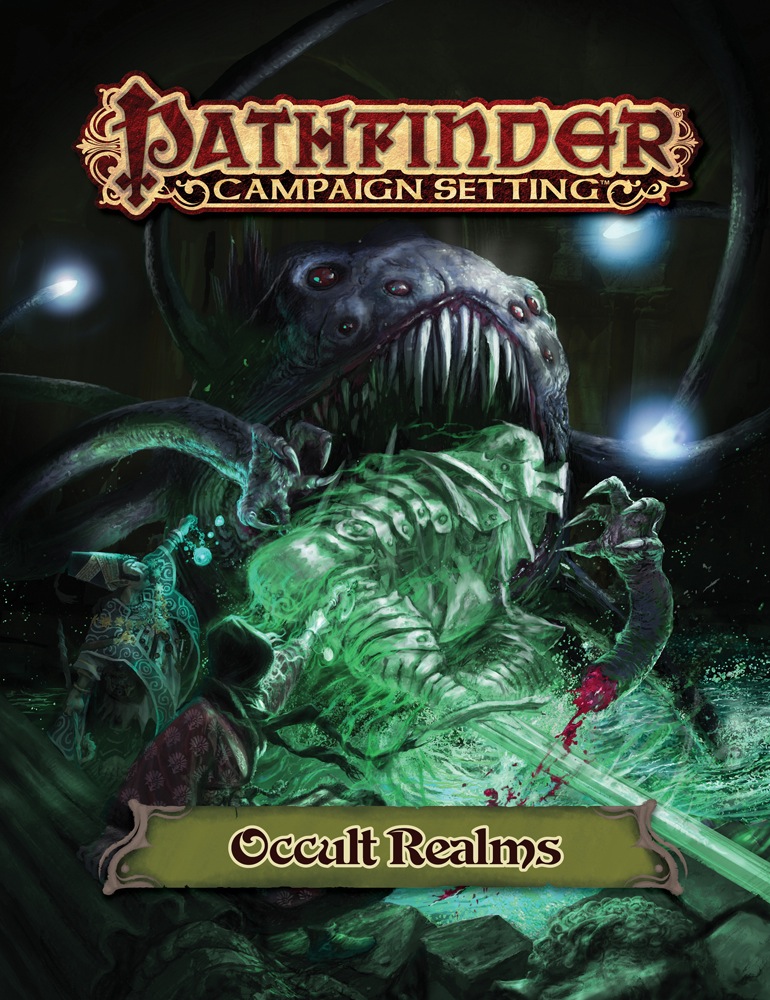
Occult Realms


One of the key things about the occult in Occult Adventures is that it is mysterious and different from everything else in Pathfinder campaigns. This is not easy to achieve when there are already scores of different kinds of creatures, abilities, and magic in the game. Yet Occult Adventures pulls it off pretty well. Since publication of that book, other books have also dealt with the occult, including Occult Origins and Occult Bestiary. Plus, Occult Mysteries, from awhile back, ties into it all as well. With each new book published, there is a danger of it losing that sense of difference.

Occult Realms is the latest book published to tie in with Occult Adventures, and thankfully, it manages to maintain that sense of mystery and the unknown. While Occult Origins and Occult Bestiary are tied to the world of Golarion, they are primarily books of mechanics. Occult Realms does have some new mechanics in it as well, but its focus is much more on descriptive detail that brings the occult fully into the campaign setting. And the mechanics it does have exist entirely to support the flavour and feel of the setting.

I have to say that I hugely enjoyed reading Occult Realms. It offers wonderful glimpses and insights into areas of Golarion that have only received a small amount of attention previously, even a place or two where you might not expect the occult, such as Razmiran. Some of the places are quite small, sometimes just a single building, but the small areas mean that the details can actually be more specific. There is a better sense of a lived-in world from this book than from some other Pathfinder Campaign Setting books, which tend to focus more on providing a list of locations than on what it's like to live there. The approach here is still on listing locations, but there is more room for detail about those locations.

Friday, 18 December 2015

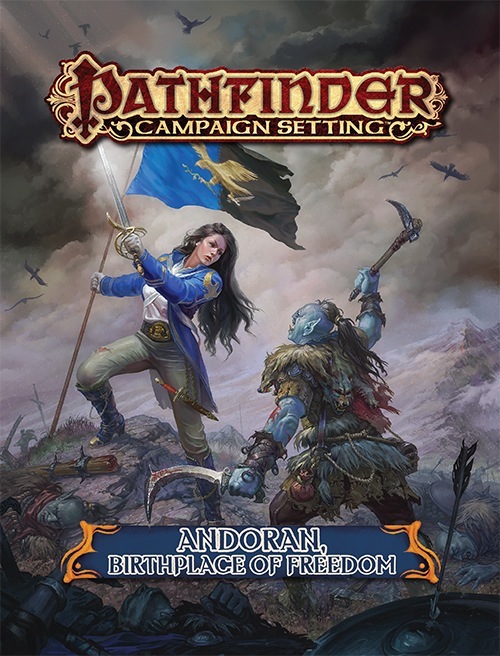
Andoran, Birthplace of Freedom


Of all the countries in the Pathfinder Campaign Setting, Andoran has, perhaps, the greatest reputation for being uninteresting. It is a land that is seen as being somewhat idyllic, a country that has worked out most of its problems. Rather unusually for a fantasy setting, it is a democracy, where everyone is theoretically treated equally and everyone has a chance to live the American dream (I use that terminology deliberately, for Andoran's real-world influence is quite obviously the United States of America; Andoran was formed by people who rebelled against the oppressive power that formerly ruled over them). While a country with few problems may be a great place to live in, it is perhaps not the greatest place to adventure in. It can seem dull, even boring.

But that's just the surface of Andoran. The country certainly isn't perfect, and there are many things going on under the surface in this land that keep it from truly reaching its vaunted ideals. While it may appear quiet and dull, there are opportunities for adventurers to make their mark—particularly in politics. That said, it can still come across as somewhat “standard” with little other than its democracy making it stand out from other fantasy settings.

Andoran, Birthplace of Freedom is not the first book published on this country. A few years ago, there was Andoran, Spirit of Liberty, part of the Pathfinder Player Companion line (then just Pathfinder Companion). Before that, there was Guide to Darkmoon Vale. That book showed just how much opportunity for adventure there is within that particular region of Andoran, and presented a setting that rose beyond its somewhat standard surface appearance. Not surprisingly, there is some overlap between the three books, but not nearly as much as one might expect, particularly between Birthplace of Freedom and Spirit of Liberty, which both nominally cover the entire country. Birthplace is twice the length of Spirit of Liberty for a start, but even so, Birthplace repeats very little from Spirit. Indeed, the two books compliment each other in a way very few Pathfinder Campaign Setting/Player Companion books do, with the earlier Spirit of Liberty offering many of the things I would otherwise criticise Birthplace for not containing.

Friday, 20 November 2015

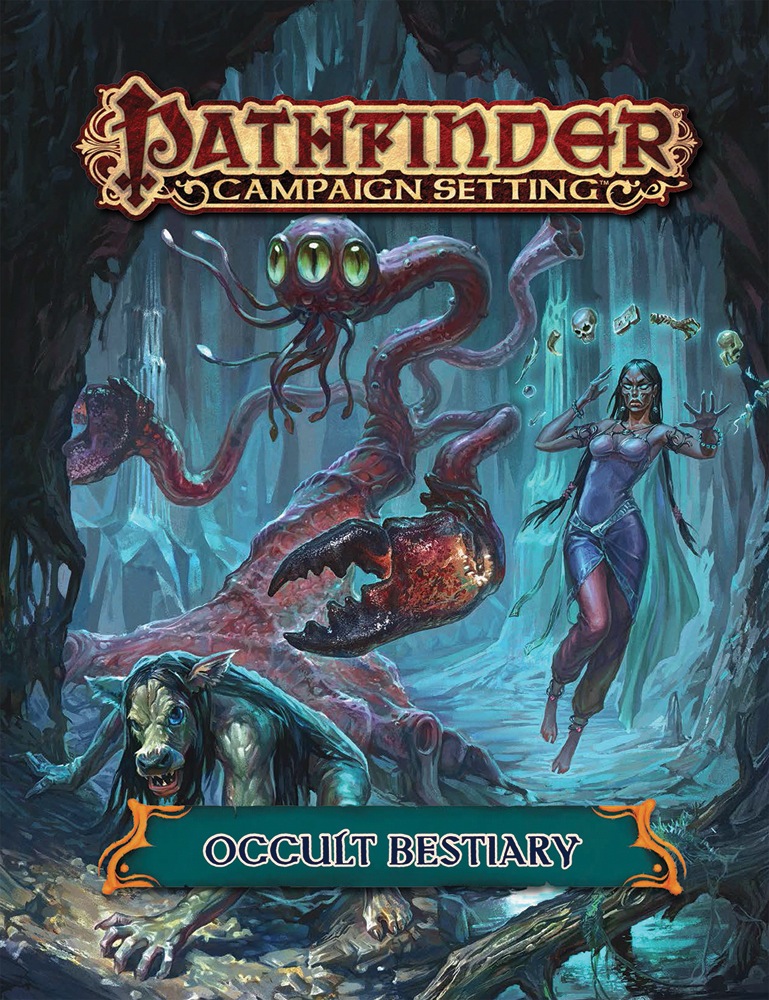
Occult Bestiary


While reading Occult Adventures, some people may be surprised that it doesn't contain any new monsters. Roleplaying books of this sort will often contain a selection of new monsters that serve both to illustrate how the new rules are used and to provide GMs with some ready-made opponents for PCs built with the new rules. Mythic Adventures, for example, has a small selection of mythic monsters for just these purposes, yet Occult Adventures has none.

The introduction to Occult Bestiary reveals that the original plan was to have a few monsters in Occult Adventures, but the limits of space meant that it just couldn't be. To have included the monsters would have meant leaving out something else. As nice as new monsters can be, it's a decision I'm glad they made as there is so much flavourful material in Occult Adventures, that there's very little I could imagine leaving out. Nevertheless, the new rules cry out for monsters that use them, and Occult Bestiary answers that cry.

Occult Bestiary contains all the monsters originally planned for Occult Adventures, plus dozens more. Now, the book is part of the Pathfinder Campaign Setting line, which means that the monsters within are tied to Golarion, whereas Occult Adventures is setting-neutral and thus any monsters that had appeared there would have been setting-neutral as well. However, it makes little difference in the end. While Occult Bestiary does use a few Golarion terms and locations, all the monsters within are easily divorced from the setting. Indeed, most of them make no explicit reference to Golarion at all. As such, this book is easily used with any campaign setting.

Thursday, 19 November 2015

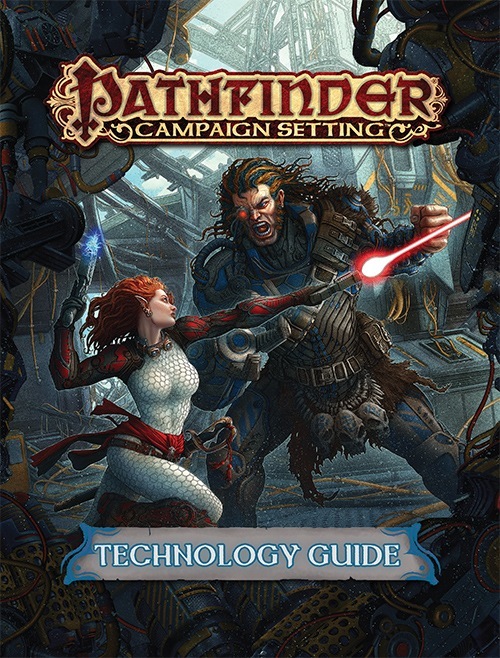
Technology Guide


Advanced technology has been present in the Pathfinder Campaign Setting since the very beginning. The old Pathfinder Chronicles: Gazetteer contains a 1-page entry on Numeria and its crashed spaceship (albeit referred to as a “great metal mountain”). It was inevitable that more detail would be forthcoming. Eventually, Numeria got its own dedicated book, Numeria, Land of Fallen Stars, and an adventure path, Iron Gods, that takes place there and exploits its science fiction aspects.

But adding technology into a fantasy game like Pathfinder takes more than just including some guns and computers in an adventure book. Not only do these things need statistics, but there also need to be consistent rules governing their use. Much like with magic items and spells, players are bound to be interested in having their characters acquire more of such items or even create them themselves. The game needs to have ways to cover such eventualities. Yet a book like Numeria, Land of Fallen Stars simply doesn't have the room to detail these kinds of rules in any extensive manner—not and have any space left over to talk about the setting. The same goes for Adventure Path volumes. Technology needs its own separate book.

That's where the Technology Guide comes in. It provides both rules necessary for integrating technology into a Pathfinder game and a plethora of sample items—big and small, low-powered and high-powered—for villains to use and player characters to acquire. Although the Technology Guide is published as part of the Pathfinder Campaign Setting line of books, this is actually a relatively setting-neutral book. It does focus on fitting its content to the flavour of Numeria and does have occasional references to places in Numeria (and elsewhere on Golarion), but for the most part, the material is generic enough for use in any campaign setting that features technology of any kind. And it's for good reason. As much as I praise world-specific content, there needs to be a baseline for the world-specific to build on. The baseline also allows people to create their own campaign worlds that use technology. It's therefore not surprising that the rules and items from the Technology Guide have been added to the Pathfinder Reference Document, which is usually reserved for material from the setting-neutral hardcover rulebooks.

Saturday, 17 October 2015

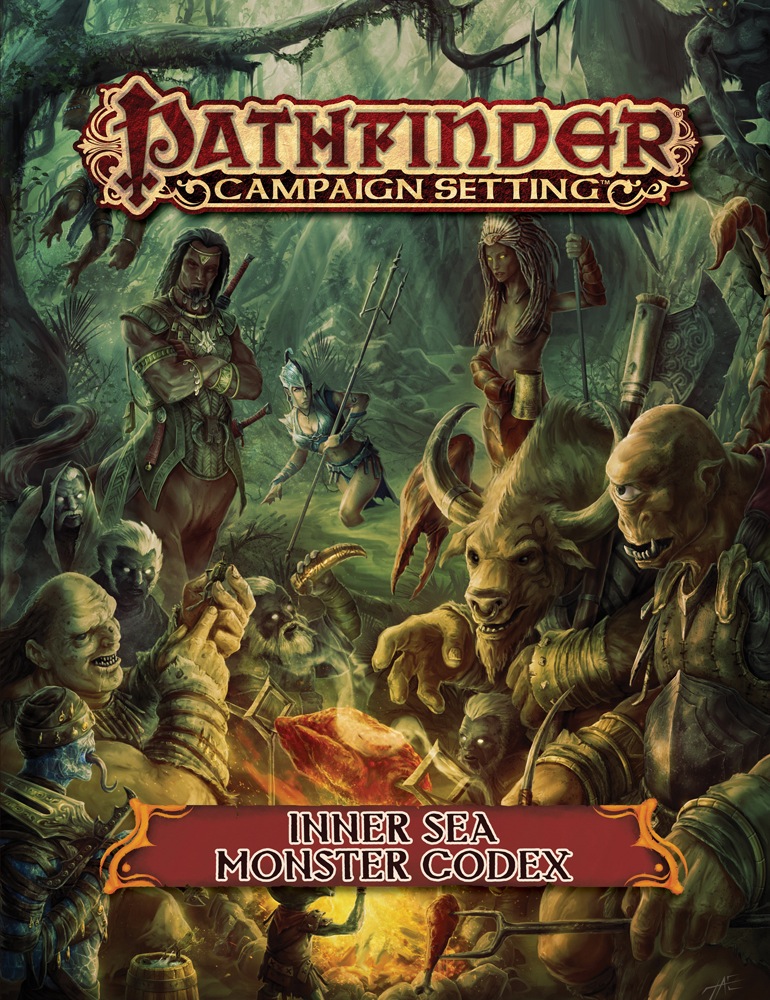
Inner Sea Monster Codex


As I stated in my recent review of it, I really can't praise the Pathfinder RPG Monster Codex enough (so true that I'm continuing my praise here!). It's a book that has seen a ton of use in my games. As such, I was quite excited by the release of Inner Sea Monster Codex, a book that serves much the same purpose as the Monster Codex, but specifically for the Pathfinder Campaign Setting. More ready-made monster NPCs can never be a bad thing!

I have to say that it hasn't seen nearly as much use as the Monster Codex. In fact, I haven't used it at all yet, although I'm sure I will at some point. Inner Sea Monster Codex covers 10 more monstrous races, several of which, like charau-ka and gillmen, are unique to Golarion. Most of these races are not quite as common as those covered in the Monster Codex, although some, like centaurs and minotaurs, are classic monsters in the game. Although I haven't used it yet (mainly because none of the monster types within have shown up in my games since its release and it's only been out a few months), I still really like the book and look forward to using it in my games. It doesn't quite reach the accolades I have for the Monster Codex as it is much more limited in space and thus variety, but it does still have a lot to offer GMs to make their games easier.

Monday, 7 July 2014

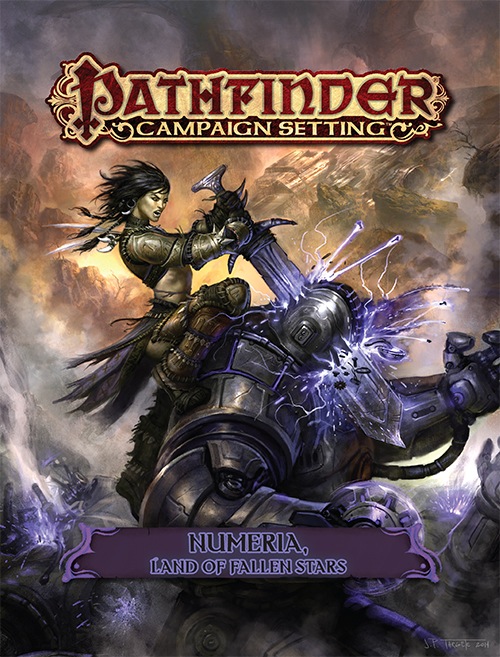
Numeria, Land of Fallen Stars


I’ve always been a fan of mixing science fiction and fantasy. I’m well aware, however, that it can be a bit of a controversial topic amongst science fiction and fantasy fans, many of whom, while enjoying both, prefer that each be kept separate. The way I look at it, though, is most science fiction contains quite a few things that are fantastical—often outright impossible—but merely presented under the guise of science instead of magic, yet accomplishing pretty much the same thing magic does. Mixing science and magic allows you to explore both in new and different ways.

Despite my love of mixing genres, I’ve surprisingly never paid much attention to Numeria, the area of the Pathfinder Campaign Setting where, long ago, a spaceship from another world crashed, and people have been trying to uncover its secrets ever since. Perhaps it’s because the books published so far have paid little attention to the area as well, and other, more-developed areas of Golarion have simply grabbed and held onto my attention. Whatever the case, the publication of Numeria, Land of Fallen Stars reminded me of this land’s existence and I eagerly dug into the book to learn more about it.

Numeria is a land where the high-technology of robots and lasers clashes with the very low-technology of barbarian tribes. There’s actually quite a lot of material to squeeze into Numeria, Land of Fallen Stars, as the various Kellid tribes that inhabit the region are not a unified people, and on top of that, there is the Technic League (a group that wants, and mostly has, a monopoly on the control and distribution of technology recovered from the crashed ship) and the crashed ship itself to describe, along with the various alien creatures, mutant beasts, and robots. Overall, Numeria, Land of Fallen Stars does a very good job of getting all this information in there and providing GMs with a compelling setting and hooks for many amazing and outlandish adventures.

Wednesday, 11 June 2014

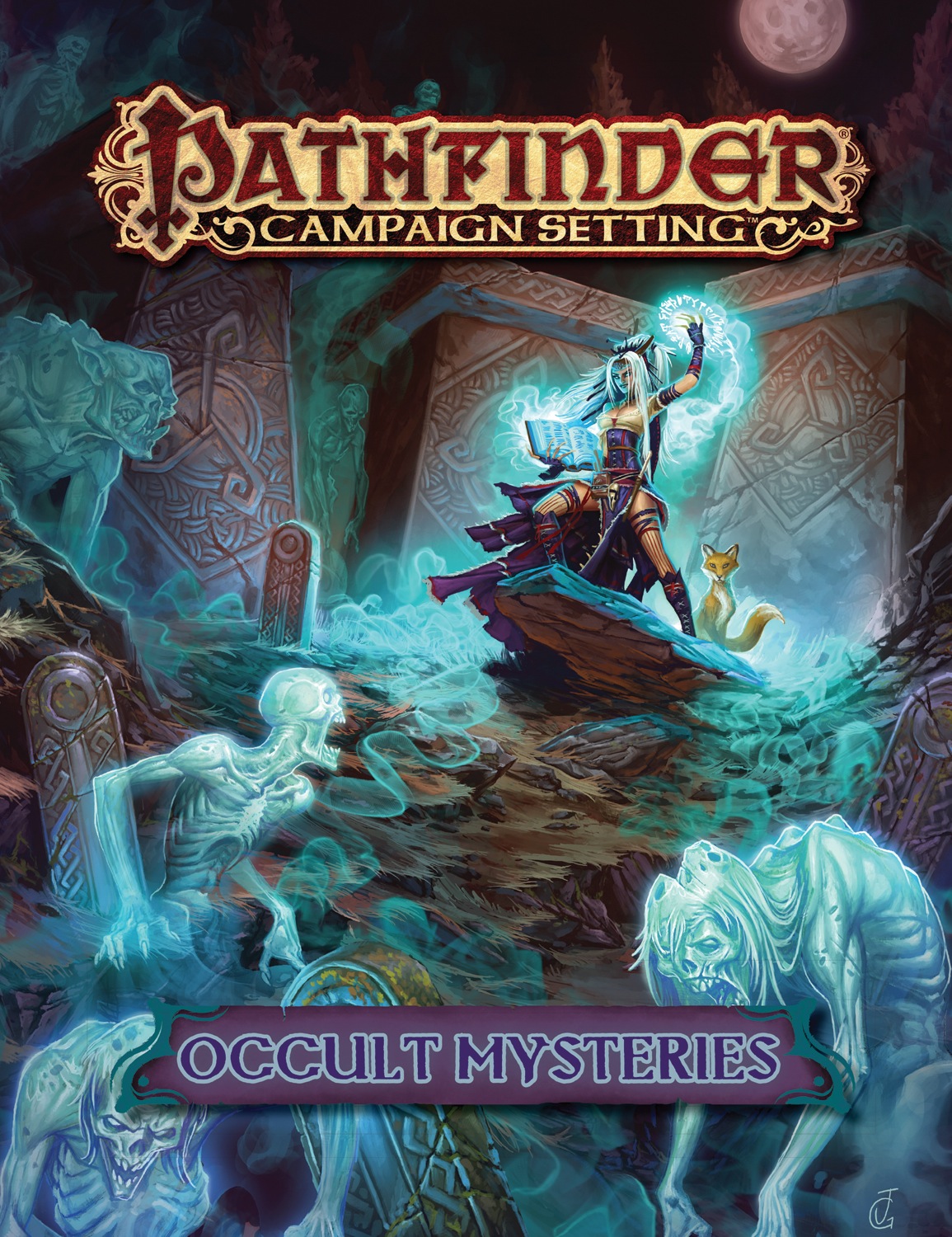
Occult Mysteries


As much as I like the Pathfinder Campaign Setting of Golarion, I’ve often felt that one area of weakness is in conveying what typical inhabitants’ lives are like. The products do a great job of setting a general tone for various areas of the setting and filling in geographical details and history. We learn a lot about the places you can visit, but a lot less about what you can do there, from the festivals and pastimes of the locals, to styles of dress, to art styles and cuisine, and to personal beliefs. I’ve mentioned more than a few times in my reviews my frustration at the lack of explanation of just what a cavalier order is—how it fits into the setting, how it interacts with governments and other organizations. The Prophets of Kalistrade are mentioned in numerous supplements as having strict dietary and sexual prohibitions, but those products never—not once!—actually say what those prohibitions are. These might seem like minor points not worth mentioning, especially since the focus of the game is on adventurers having adventures, not adventurers having normal, everyday lives. However, it’s often the little details that add the most flavour. They may be background elements, but they help to make the setting seem more real and alive.

Occult Mysteries is a product that takes a step towards addressing some of these issues. It doesn’t answer the questions about cavalier orders and the Prophets of Kalistrade, and it doesn’t give information about day-to-day life in any particular part of the world. However, it does offer incredible insight into the beliefs of the people of Golarion, and into their thought processes. The book looks at a number of “mysteries” from across the world—the strange things that people haven’t quite been able to explain, but have many hypotheses about. These include creation stories, the exodus of the gnomes, and the missing Volume 5 of the Pathfinder Chronicles. The book also looks at traditions like astrology and numerology, secret societies, and infamous texts of great power.

Monday, 19 May 2014

Inner Sea Combat


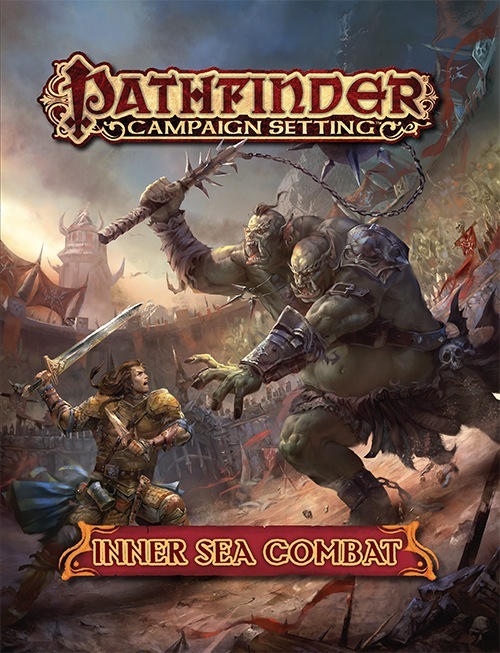
I’m a bit surprised it took as long as it did for Inner Sea Combat to come out. After all, it’s been over two years since Inner Sea Magic was released, and the two books seem obvious companion books (in the same sort of way one can think of Ultimate Magic and Ultimate Combat as companion books). However, whatever the reason for the long gap between the books, it’s good to see combat in the Pathfinder Campaign Setting getting the same attention that magic has already gotten.

Inner Sea Combat provides a ton of new options for combat-oriented characters. But this is more than just a book of new feats and other new rules options. Everything in this book is tied to the Golarion setting and, while it’s certainly possible to separate the new options from the setting and use them without the context, I honestly think most of them will lose a great deal in such a case. There’s a wonderful amount of flavour to the options in this book, and they all build on aspects of the campaign setting—many of them things that have been mentioned in other books but not dealt with in detail until now. The book is organized similarly to Inner Sea Magic, opening with a descriptive look at combat across the Inner Sea region (including a list of prominent NPCs), then providing details on variant forms of combat, new character options including a couple of prestige classes and a ton of new archetypes, and ending with an extensive selection of new magic items. People who criticize Ultimate Combat for having a spells chapter will be happy to know that there are no new spells in this book.

Thursday, 1 May 2014

Inner Sea Gods


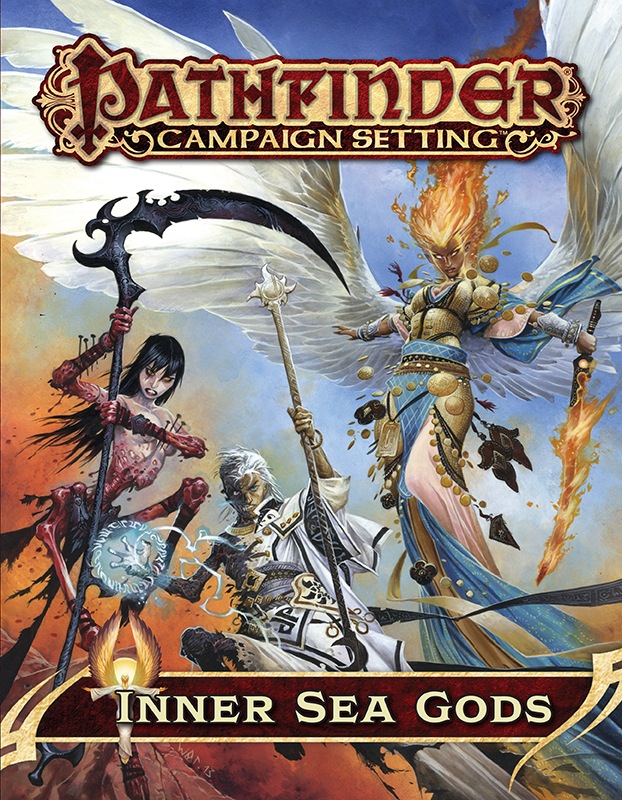
The gods and their followers make up an important part of any fantasy campaign setting. They provide the myths and legends of the world, and their religions help define the ways the people of the world go about their lives from day to day, month to month, and year to year. In Pathfinder and many other games, the gods also provide their most favoured servants with power, often in the form of spells, but also other unique abilities as well. Thus, having a well-defined pantheon of gods is integral to creating a coherent setting.

The gods of the Pathfinder Campaign Setting world of Golarion have been developed over several years now, beginning as just a list of names and domains in the original Rise of the Runelords Player’s Guide, but were then gradually expanded upon with occasional articles dedicated to individual deities appearing in Pathfinder Adventure Path volumes. It wasn’t long before they got a book dedicated to them in Gods and Magic. But that book, at 64 pages, could only hold so much. It’s an overview, really, and as the campaign world has expanded and developed, that book has become less and less useful. There is far more detailed information available in the aforementioned Pathfinder Adventure Path articles and books like Faiths of Purity, Faiths of Balance, Faiths of Corruption, and Faiths & Philosophies. But one problem with all this information is that it is scattered across more than twenty different books, which can make it difficult to find when needed.

Inner Sea Gods, a massive 336-page hardcover tome, helps rectify that problem and introduces lots of new material for both GMs and players. To be fair, some people may see a lot of the material in this book as a retread. It does compile the Pathfinder Adventure Path articles on the 20 core gods of the Inner Sea Region into one place, and that fills up the entire first half of the book. The information on the other gods is also mostly compiled from other sources, leaving about a third of the book to completely new material (mostly game options like new feats, spells, traits, and prestige classes). However, the book has done more than just compile the older information. It has also revised that information to bring it in line with the way the setting has developed and even changed since the material was first published. Gone are paladins of Asmodeus (well, actual lawful good paladins, that is; people claiming to be paladins of Asmodeus are still very much present) and Erastil’s misogyny, and numerous other small revisions can be found by those who look closely enough.

Inner Sea Gods is really quite a remarkable book. The interior layout is absolutely gorgeous. More important than that, the content is full of flavourful information that will leave GMs with tons of material to create new NPCs and plots with. And although there’s a huge amount of information to absorb, it’s a fun and entertaining read from beginning to end.

Tuesday, 4 March 2014

February Round-Up, Pathfinder Legends, and Wrath of the Righteous Poster Map Folio


Another month has come and gone. It was a fairly quiet month for me here on the blog, particularly in the world of Doctor Who. However, I did review the excellent and very important book Doctor Who and Race. I highly recommend people read it! I also wrapped up the third series of Sherlock with “His Last Vow” and took a little look back at Babylon 5 in honour of its 20th anniversary. In the world of Pathfinder, I looked at three products: Herald of the Ivory Labyrinth, People of the Sands, and Osirion, Legacy of Pharaohs.

In some exciting Pathfinder news, this month sees the release of the first Pathfinder Legends, a series of audio dramas from Big Finish, who are most well known for their Doctor Who audio dramas. The first release is Rise of the Runelords: Burnt Offerings, based, of course, on the first Pathfinder Adventure Path volume. You can listen to a trailer at the link. To be honest, I’m not all that impressed by the trailer, which surprises me as you would expect the trailer to showcase the very best of the production. Still, Big Finish has a very good record with their Doctor Who audios—enough of a record that I am very confident in their ability to do a very good job with Pathfinder Legends. You can purchase copies from Big Finish or from Paizo. Alas, much like with Big Finish’s Doctor Who material, personal budgetary constraints mean I’m not going to be able to pick any of these up in the near future. Hopefully one day, though. One day...

I’ll wrap things up with a short review. Here’s to a great March!

Wrath of the Righteous Poster Map Folio

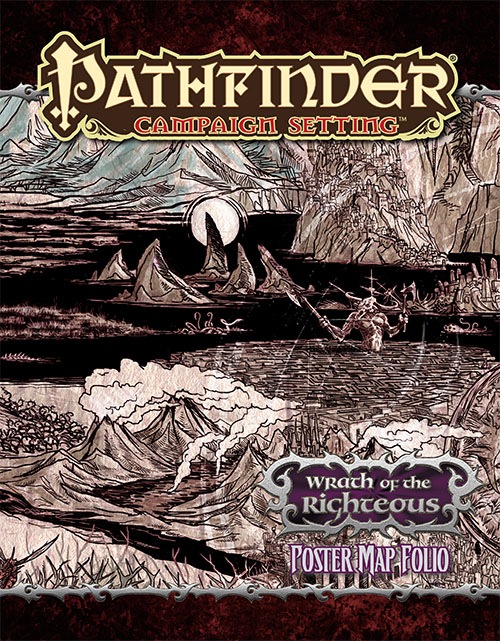
As with most map folios for the adventure paths, the Wrath of the Righteous Poster Map Folio comes with three large, full-colour maps. One is a map of the Worldwound, the area where most of the action of Wrath of the Righteous takes place. The second map is of Kenabres, the city where the adventure path begins in The Worldwound Incursion. Both of these maps are high-quality and beautiful to look at, while also being highly useful for playing the adventure path. Admittedly, the map of Kenabres is really only useful for the first adventure, but the map of the Worldwound will be useful right up to the final instalment.

However, the stand-out map of this set is the third one: a map of the Abyss (which the PCs travel to in the fourth and fifth instalments of Wrath of the Righteous). Mapping out the Abyss is a daunting task—no, more an impossible task really, considering the Abyss is essentially an infinite plane made up of countless other planes. What this map does instead is provide an artistic rendition of the various Abyssal realms and “where” (metaphorically speaking) they are in relation to each other. Admittedly, the map doesn’t have a lot of utility in actual game-play. However, I don’t really care. The map is utterly beautiful to behold and can easily serve as an in-game representation of the Abyss—something the players’ characters might actually see. Ultimately, this map provides a visual element to enhance game-play. It gives both players and GMs just a little hint on what their characters are seeing, allowing the imagination to fill in the rest. It also makes a great poster to hang on the wall.